


Spain’s market for solar installations and self-consumption has entered a new phase of maturity and consolidation following the “Great Blackout” of spring 2025. This is reported in “InformeSolar 2025: Radiografía del autoconsumo en España,” published by SotySolar in collaboration with the Spanish solar association UNEF, Huawei, Pontio, BayWa r.e., 8-33 and Clevergy. The study examines the motivations and behaviour of Spanish consumers, revealing a significant shift in their approach to solar energy.
Power outage as a market turning point
SotySolar
The widespread power outage in spring 2025, which affected millions of households on the Iberian Peninsula, triggered a surge in interest in solar installations and home storage systems. Since then, self-consumption is seen not just as a way to save money, but increasingly as a guarantee of resilience and independence. According to the study, cost savings remain the main reason for installing solar systems, at 65 percent (up from 60 percent in 2024). At the same time, sustainability (12 percent) and energy independence (8 percent) are becoming more important.
Cegasa’s Iñigo Atutxa: “Storage and grid services drive the future”
“Self-consumption in Spain is no longer an expensive niche technology, but an everyday, reliable and essential household appliance,” says José Donoso, Director General of UNEF. He adds that after the blackout, the market has shifted from a pure cost-saving model to one focused on complete energy independence. Solar installations are now increasingly combined with battery storage, electric vehicles and heat pumps to create self-sufficient and sustainable homes.
Heat pumps gaining importance
The study highlights that heat pumps (aerotermia) are rapidly gaining traction in Spain. While many homeowners considered the technology too expensive and unfamiliar in 2024, by 2025, 66 percent of solar installation owners plan to install a heat pump within the next three years. The report notes that demand for heat pumps is less dependent on energy prices or crises, and is instead driven by seasonal climate needs and growing awareness of efficiency.
Madrid steers €818 million in EU funds to energy storage
Another trend is the rise of flexible financing models. In 2024, 73 percent of homeowners were unaware of funding opportunities and discouraged by high upfront costs. By 2025, however, 60 to 70 percent of households are using flexible payment options. For projects over €10,000 or those with battery storage, this figure reaches 80 percent. Digital financing, where instalment payments only begin after commissioning, is significantly lowering entry barriers. According to Pontio, more than 10,000 installations will be financed in 2026.
Regional differences in funding programmes
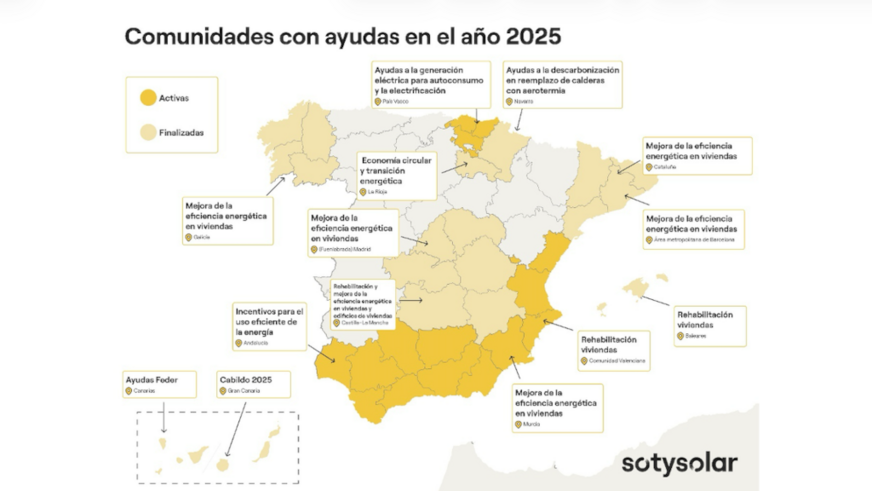
With the phasing out of the European Next Generation funds, the market has moved from a reliance on subsidies to a structurally profitable model. The study shows that the effectiveness of funding programmes varies greatly by region. In Catalonia, targeted subsidies led to a 20.6 percent increase in interest. Similar results are seen in other regions, such as decarbonisation programmes in Navarre and energy efficiency initiatives in Andalusia, Murcia, Galicia and the Basque Country.
UNEF calls for easing of self-consumption rules
Uncertainty in the energy market has led 71 percent of Spaniards to prefer stable energy tariffs. Self-consumption is seen as a key tool for cost control. While price remains an important factor in choosing an installer (45 percent), recommendations (25 percent) and support with applications and funding (20 percent) are becoming more significant. The demand for comprehensive and reliable services is on the rise. (nhp)