



On 29 April 2026 in Frankfurt am Main, Huawei Digital Power launched the FusionSolar 9.0 solar solution for the European market. The platform is aimed at utilities, project developers and plant operators. According to the supplier, it is tailored to the requirements of solar power plants in the megawatt and gigawatt range and enables a lower levelised cost of electricity (LCOE) across the full lifecycle.
1,000 volts AC and grid-forming string inverter
Niels H. Petersen
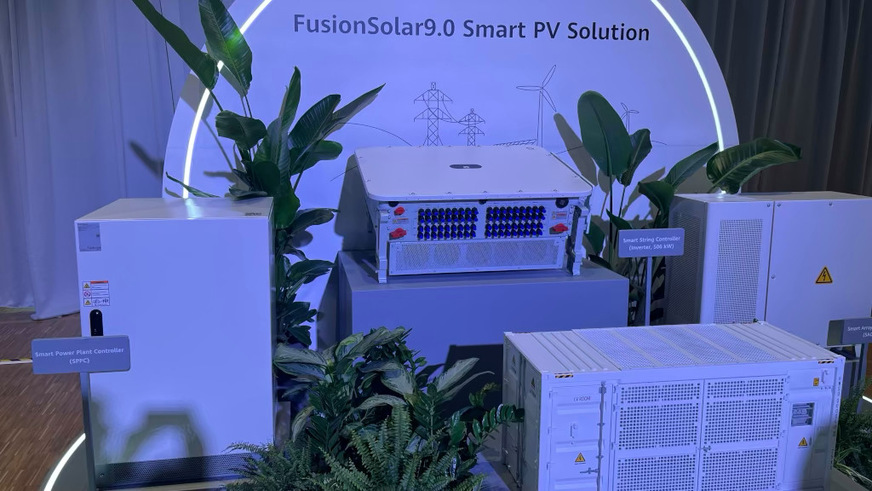
According to Huawei, the new solution incorporates several industry firsts. For the first time, a photovoltaic system operates at 1,000 volts AC. Until now, 500 or 800 volts AC have been standard. The higher voltage allows longer strings and thereby reduces the cost of system peripherals, or balance of system (BOS). The second innovation, the company says, is the first string inverter with grid-forming functionality.
Huawei FusionSolar – utility storage with a Prime security certificate
Until now, this capability has been limited to battery storage systems. Solar plants can therefore actively support voltage and frequency in the grid. Added to this is a transformer station rated at 11 megavolt-amperes, which Huawei says is the largest of its kind in Europe. The innovations are implemented in the new 506KTL string inverter and in a new generation of transformer stations rated at 3, 7 and 11 MVA.
Hard numbers on system cost savings
Huawei puts the savings on BOS costs at 0.27 to 0.55 eurocents per watt of capacity. According to the company, these result from the string configuration of up to 11 MW that the 506KTL enables. For a project of around 200 MW, some 70,000 euros are also said to be saved during commissioning, as the grid-forming function removes the need for diesel generators at start-up. An extended MPPT voltage range and longer strings further extend the effective generation time per day.
Huawei FusionSolar – storage with hybrid cooling
According to Huawei, the grid-forming function delivers reactive power in under ten milliseconds, three times faster than grid-following inverters. A virtual inertia of zero to 20 seconds is intended to support frequency stability. Automatic restoration of reactive power after night-time faults is designed to help avoid penalties under grid connection rules.
Better safety, more efficient cooling
Niels H. Petersen
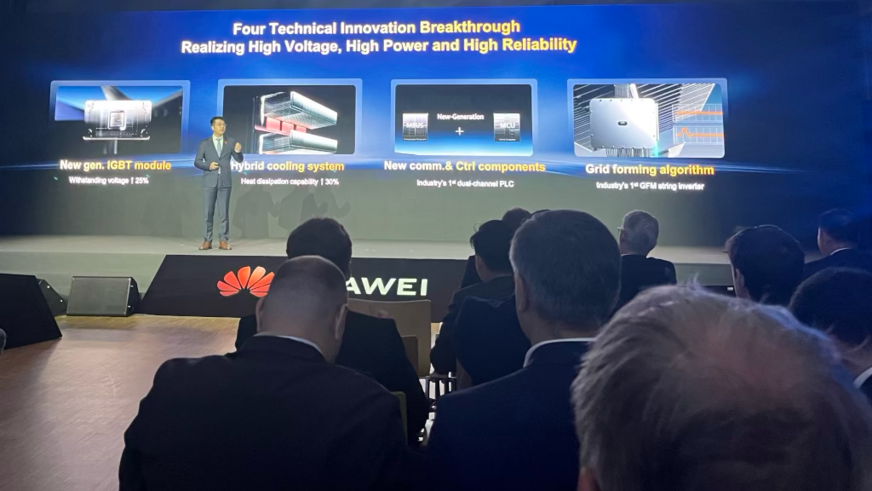
The Smart Hybrid Cooling system, which the company describes as an industry first, improves heat dissipation by 30 percent. A three-stage DC protection system (SSLD v2.0) actively detects faults and shuts down within milliseconds. The new IGBT module offers 25 percent higher voltage resistance, 10 percent lower losses and a 20 percent higher maximum junction temperature.
Stay up to date – sign up for our newsletter
Huawei says it has been deploying FusionSolar 9.0 in the Chinese market since October 2024. Globally, more than 10 GW of projects using the solution are under construction. The supply chain for 1,000-volt AC components, including modules, switches and transformers, is ready for the European market.
Resetting expectations for utility-scale
"FusionSolar 9.0 is not just a product update," said Steve Zhang, President of the Utility, Commercial & Industrial Solar Business Unit at Huawei Digital Power, addressing around 400 attendees. "It is a fundamental redefinition of what a solar plant must be capable of delivering in 2026 and beyond." Jacky Chen, President of Huawei Digital Power Europe, added: "The question is no longer how much renewable capacity we can install, but how we ensure that this capacity is intelligent, grid-stable and economically resilient across its full lifecycle." (nhp)