



Solar power from farmland was one of the standout topics at Genera 2026, and the Spanish photovoltaic association Unión Española Fotovoltaica (UNEF) came with a milestone to report. Spain’s agrivoltaic pipeline now exceeds 1 GW.
Genera 2026 makes the case for smarter storage
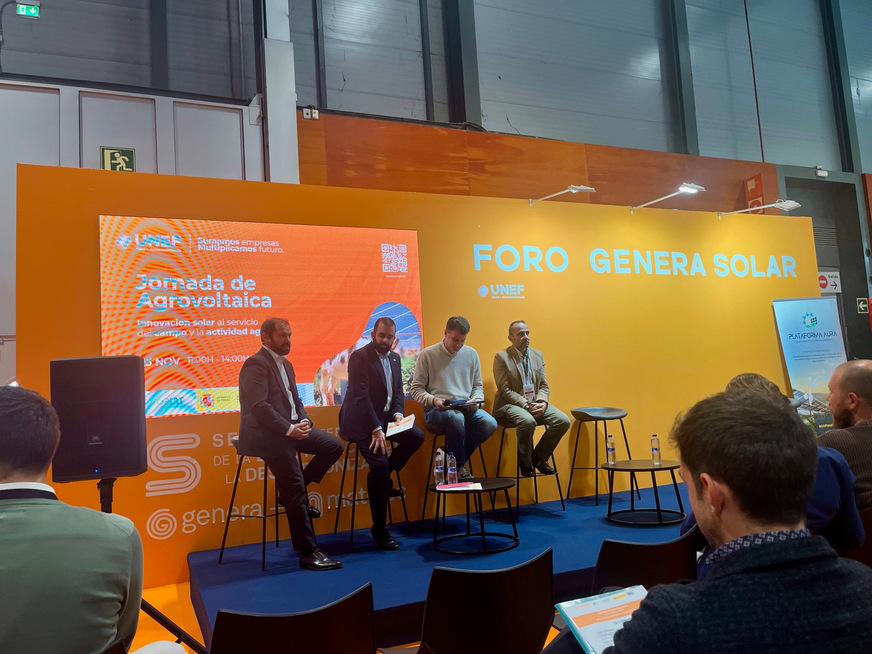
José Donoso, the association’s director general, said that 1 GW of projects is already in the pipeline and that this growth has been made possible above all by the state support programme RENOINN, short for “Renovables Innovadoras,” or innovative renewable energies. UNEF describes this as a turning point.
An opportunity for agricultural cooperatives
Two or three years ago, according to Donoso, there were only small pilot projects. UNEF is now banking on a demonstration effect, and once the first installations show that they can boost agricultural output, more farmers are expected to follow. Donoso added that Spain’s entire solar build-out would require just 0.3 percent of the country’s rural land.
The association also sees opportunities for agricultural cooperatives, which could evolve into energy communities and run their own self-supply projects. In UNEF’s view, agrivoltaics, self-consumption and energy communities could together transform rural areas.
A pilot project in viticulture
Niels H. Petersen
Cristina Aparicio Maeztu, director for energy transition and the circular economy at the Comunidad de Madrid, set out the potential at European level. If just 1 percent of Europe’s agricultural land were used, she said, 944 GW of solar capacity could be installed, 20 times what is currently installed in Spain.
Spain – solar's success becomes its economic challenge
The Madrid region is now planning its own pilot project, which will start by combining viticulture with solar installations and test whether the planned regulatory framework works in practice. Five principles matter to Aparicio: agriculture takes priority, followed by the right system design, protection of the soil, active involvement of farmers and continuous monitoring.
Definition and rules still missing
The biggest obstacle so far is the absence of a uniform national definition of agrivoltaics, and Aparicio is calling for a nationwide framework. She points to France as a model, where the rules are built around crop yields and impose fewer rigid technical requirements, such as minimum module heights.
If no national regulation emerges, the Comunidad de Madrid is prepared to issue its own decree. The term agrivoltaics does not yet appear in Spain’s National Energy and Climate Plan, and Aparicio criticises the plan for mentioning agriculture only in connection with greenhouse gases, without treating it as part of the answer.
New Aura platform
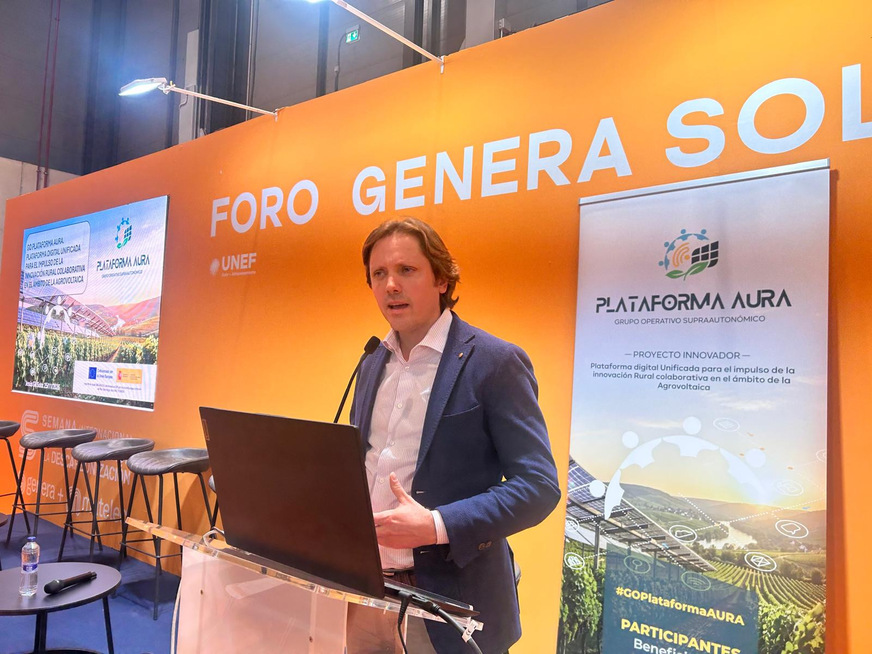
On the second and much busier day of the fair, a consortium from the agricultural and solar sectors presented its Aura Platform project, whose full title is “Digital Unified Platform for the Promotion of Collaborative Rural Innovation in Agrivoltaics.” The Spanish Ministry of Agriculture is funding the initiative.
Floating solar makes a splash in Europe
The consortium brings together science, agriculture and the energy sector. Partners include the national agricultural technology centre Ctaex, UNEF, the Fundación Ayesa and the young farmers’ association Asociación Agraria de Jóvenes Agricultores, while the Fundación Cooprado, BayWa and the University of Córdoba are also involved.
Solar know-how for farmers
UNEF
At its heart is an online platform for farmers, beekeepers, energy companies and researchers, which is meant to make information, practical examples and shared experience easier to access. A collection of best practices and reference projects is also planned, so that successful models can be transferred to other regions.
Agri-PV: financing hinges on agricultural viability
The consortium also plans training courses for farmers and beekeepers. “Agrivoltaics makes it possible to combine crop farming, livestock production or beekeeping with solar power on the same land,” says Jesús Gil Soto, who heads research and development in agriculture at Ctaex. In his view, combining the two opens up new sources of income and makes better use of the land.
Focus on acceptance
The project will also address public acceptance, with a study examining what is slowing adoption and how those barriers can be overcome. One focus is on green entrepreneurship and generational renewal in farming. The budget is around €600,000, and the European Union is covering 80 percent of it through the European Agricultural Fund for Rural Development, under Spain’s strategic plan for the Common Agricultural Policy.
Genera 2026 shows that Spain's agrivoltaics sector is moving out of the pilot phase. The first gigawatt is in the pipeline, and knowledge and networks are growing. Whether this spark of optimism actually reaches the farmers on the ground will be decided across town in Madrid, where the missing national rules have yet to be written. (nhp, Madrid)