



This year’s EnergyDecentral, organised by the German Agricultural Society (DLG), was once again well attended. Farmers came to the exhibition halls in Hanover to find out about the latest options for supplying their operations with their own energy. Besides the solar energy transition on farms, visitors focused on the dual use of land for agricultural production and solar generation.
Exhibitors described conversations at the stands as almost uniformly productive, and said farmers arrived noticeably better informed and better prepared than two years ago. Providers of solar systems and storage, direct marketers and project developers all reported that the emphasis in these conversations had shifted significantly.
Get the latest on PV for agriculture – subscribe to our free monthly newsletter for farmers
Uncertainty over the EEG
vMany want to overhaul the energy supply on their farms and move into solar generation, but the lack of clear rules leaves them hesitant. Exhibitors blamed the delay to the amendment of Germany’s Renewable Energy Sources Act (EEG) at the Federal Ministry for Economic Affairs, which several described as unnecessary.
EnergyDecentral 2026 names its innovation medal winners
According to exhibitors, the result is weaker demand than in previous years. Interest in the solar energy transition in agriculture nonetheless remains high, even if farmers now need more explanation. The transition is becoming more complex, they said, because the regulatory environment is unclear and full of obstacles.
Velka Botička
Grid remains the bottleneck
On top of the uncertainty over which rules will apply from next year, farmers are frustrated by slow communication with grid operators and a lack of grid connections. Exhibitors and farmers alike were clear that the long-delayed grid expansion is the key bottleneck for project implementation.
Double harvest from field and pasture – solar income for farmers
Nevertheless, many farmers are pressing ahead. Older farm managers in particular, who are dealing with succession planning, know that things cannot continue as before. They are asking themselves what to do with their land, how to work it in future and how to get two or three uses out of plots with weaker soils. According to exhibitors, farmers are also well aware that energy on the land can generate considerably more income than arable farming alone.
Strong demand for storage
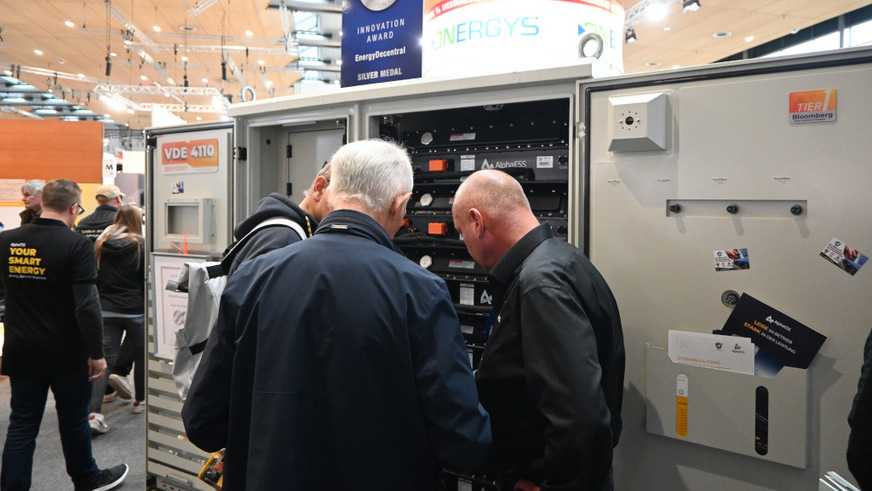
Limited grid capacity and falling midday prices on the power exchange meant that most questions at the stands concerned battery storage. Farmers wanted to know how to obtain approval for such systems and how large a battery needs to be for the power from an agri-PV installation or a rooftop solar system on a barn to find a buyer. Exhibitors said hardly any farmer now regards solar installations without storage as viable, and many see storage as the key to making photovoltaics in agriculture work in the first place.
For more information about solar transitions on farms, visit our special topic
Storage has further functions on the farm. It secures supply to agricultural loads such as heating, ventilation, milking and cleaning systems, and it can also prevent biogas plants from standing idle. Exhibitors reported that for farmers, installing a storage system is cheaper than restarting a biomass plant after an unplanned shutdown.
Beyond the feed-in tariff
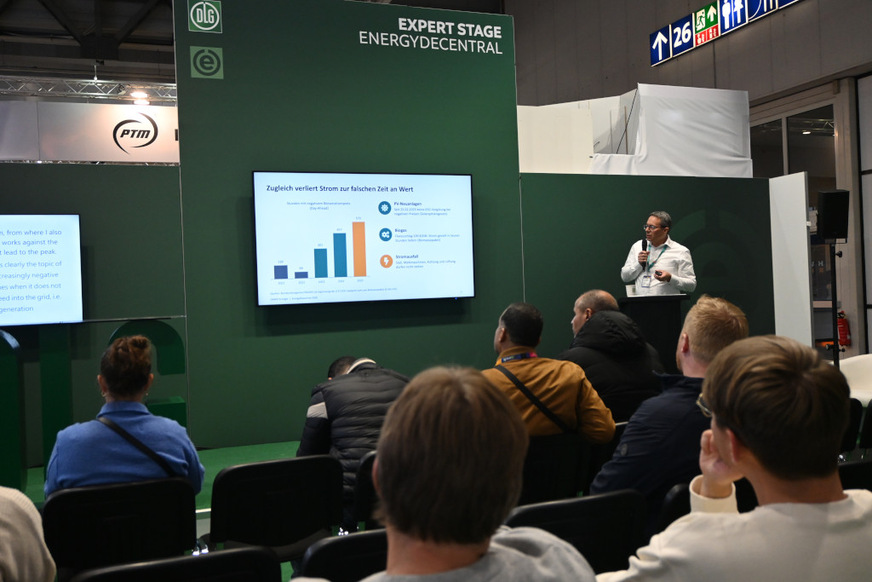
Farmers also associate storage with better opportunities to market their power. Anyone deciding on a solar installation today wants to know how they can still sell the power they do not consume themselves at a good price, and the same applies to older installations whose feed-in tariffs are running out. Farmers are asking specifically about marketing in combination with storage, and about how to avoid losses from negative electricity prices. They also want to know how to align self-consumption and feed-in without having to cover their own demand from the grid during curtailment.
Municipal utilities can help here. Long-term supply contracts with municipal utilities or industrial buyers are now regarded by many as an alternative to the EEG tenders, as a fixed price over ten years makes it easier to finance projects through the farmer’s own bank.
Velka Botička
Farmers are better informed
These detailed questions bear out what exhibitors said earlier about better-prepared visitors. Farmers are more knowledgeable now and are looking specifically for partners offering more than standard project development. Visitors turning up at a stand with a cadastral map, simply wanting to know whether anything can be done with their land at all, have become rarer. Many are also holding back on leasing out land, because at present no one can say how likely a project is to be realised.
Those who are planning in concrete terms, by contrast, expect firm figures quickly. Farmers want an offer, or at least a reliable ballpark, for an installation with storage, ideally on the spot. For exhibitors, this is a sign that the energy transition in agriculture is continuing, with project partners working out answers that policymakers have yet to provide. (su)