



Revolta’s new battery is aimed at households that have so far managed without home storage, in particular tenants in smaller flats with no solar system of their own. The plug-and-play unit connects straight to the grid, charging when electricity is cheap and discharging when prices peak. Beyond trimming household bills, Revolta sees the system as a way to make the grid more flexible and stable.
Narrowing the angle – a simple fix for solar cell losses
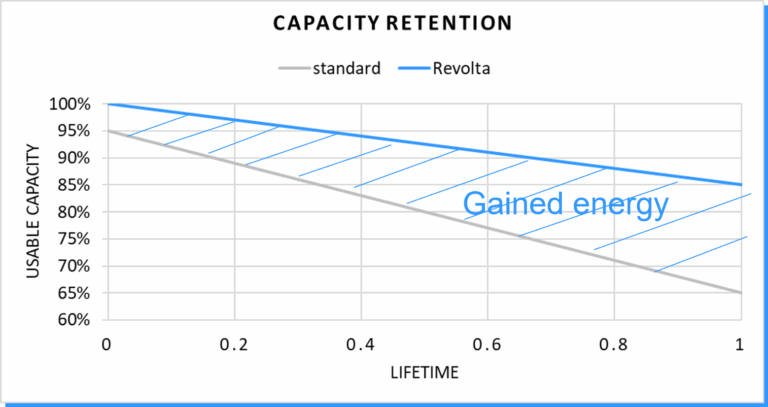
At its core are sodium-ion cells, which use neither lithium nor cobalt. Revolta says the chemistry lets it combine high safety standards and sustainability with efficient storage. Sodium-ion cells are known for their thermal stability, which lowers the risk of overheating and thermal runaway. The company also claims its batteries keep more of their usable capacity over their lifetime than conventional systems. It has not yet disclosed the unit’s capacity, power rating, price or launch date.
A sodium-ion line-up in the making
The new battery builds on technology Revolta unveiled earlier this year. At The smarter E Europe in Munich, the company presented what it describes as the first high-voltage sodium-ion home battery, designed for households with PV. That system’s 2 kWh modules can be combined for up to 20 kWh of storage, and Revolta expects its sales network to be fully in place by 2027.
Revolta
Since 1 October, rules from Germany’s Federal Network Agency (Bundesnetzagentur) have allowed storage systems to charge from the grid and feed the power back later, with reduced levies and grid fees on the electricity they return. That also applies to storage systems with no generation of their own, which covers the tenant households that Revolta is targeting.
Green roofs and big modules: K2’s fast, flexible answer for large flat roofs
Revolta’s development work is backed by public funding. A grant from the European Regional Development Fund (ERDF) covers 40 percent of the project’s €660,545 in eligible costs and runs until the end of 2029. It follows a €124,940 grant from the German Federal Environmental Foundation (DBU) for a related storage project.
“The funding confirms the importance of new energy storage technologies for the energy transition and enables us to further develop our sodium-ion technology for applications that can particularly benefit those parts of the population that have so far had limited opportunities to participate in the energy transition,” said Julian Mattheis, chief executive of Revolta. (TF)