



The Fraunhofer Institute for Solar Energy Systems ISE in Freiburg has developed a new battery electrode architecture that allows cells to store 10 to 15 percent more energy at the same weight, working with industry partners to validate the approach across three different battery chemistries.
BMS innovation driving a $320 billion battery market
Conventional battery electrodes consist of many thin, alternating layers of coating and current collectors. In their work, the Fraunhofer team managed to more than tripled the thickness of the electrode coating, from a standard 100 to 200 micrometres up to 800 micrometres, reducing the number of current collectors needed and freeing up more space for active material. “We've increased the thickness of the electrode coating from the previously standard 100 to 200 micrometres to up to 800 micrometres, thereby significantly reducing the number of current collectors required,” said Dr. Oliver Fitz, group leader for battery cell technology at Fraunhofer ISE. “As a result, we have much more space for active material, which increases the energy density by 10 to 15 percent, depending on the battery type and design.”
Validated for three chemistries
The team first tested the architecture in small laboratory cells across zinc-ion, sodium-ion and lithium-ion chemistries, before manufacturing lithium-ion pouch cell prototypes on a semi-automated production line at the institute's Battery Materials and Cell Production Lab, using industry-standard processes. The cells are PFAS-free and manufactured without toxic solvents. Fitz said the underlying cell concept “can also be easily adapted to other cell chemistries.”
Designed with manufacturing in mind
The architecture was developed with an eye on future mass production: a production line built around it would carry significantly lower process complexity than current wet-coating systems, cutting both capital costs and the space and energy needed to operate it. Fraunhofer ISE says that could open the door for small and medium-sized manufacturers to establish battery cell production in Germany. Industry partner Helmut Hechinger, an automotive supplier now generating more than 30 percent of its revenue from e-mobility, said it could explore industrialising the technology if further scale-up and validation prove promising, citing particular potential in Baden-Württemberg for stationary storage production.
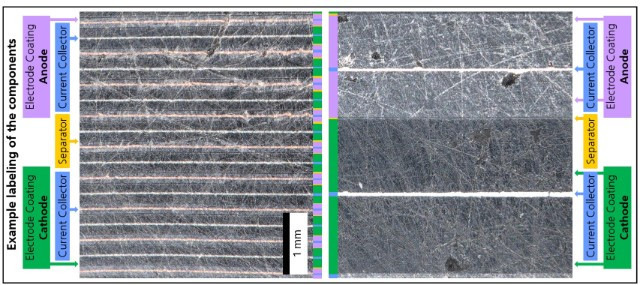
Fraunhofer ISE
Fraunhofer cracks megawatt EV charging on a small grid link
Prof. Dr. Andreas Bett, director of Fraunhofer ISE, said stationary battery storage is “an integral component for covering morning and evening electricity peaks” in a climate-neutral energy system with fluctuating renewables. Pointing to California, where battery storage already supplies most evening electricity, he said Germany “would be well advised to build up manufacturing capacity to meet the growing demand for batteries and thereby create value within the country.” The work was carried out under three research projects, VORAN, INFAB and WinZIB2, funded by Germany's economics and research ministries alongside the Baden-Württemberg state government. (TF)