



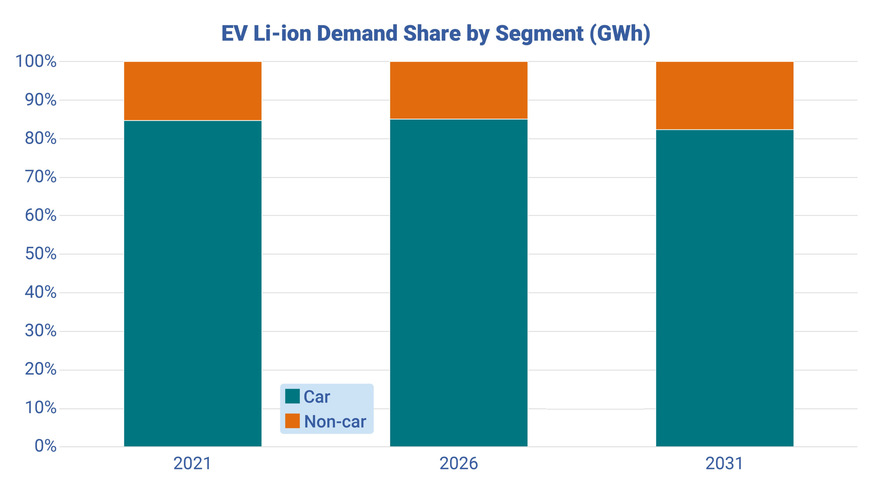
Battery management systems, once a background component tucked inside an EV pack, are becoming one of the more active fronts in the industry's push for faster charging, longer battery life and better safety. Market research firm IDTechEx expects global Li-ion demand for electric vehicles to grow from 4,500 GWh by 2036, with the underlying market climbing from $170 billion in 2026 to $320 billion over the same period. A new report from the firm, "Li-ion Batteries and Battery Management Systems for Electric Vehicles 2026-2036", profiling 23 companies across cells, packs and BMS, maps how the technology is evolving.
IDTechEx Research
Battery fire rates have fallen sharply since the 2010s even as pack capacities have grown, a trend the report attributes to parallel improvements across sensors, fire protection materials, thermal management and the BMS itself. The BMS functions as the pack's central controller, taking in sensor data and using it to keep the battery operating within safe limits.
Fraunhofer-led project scales up charging for heavy-duty transport
Two distinct approaches are driving current development. On the software side, Iontra, Elysia, GBatteries and Breathe Batteries are working on adaptive charging algorithms, while Eatron and Qnovo focus on diagnostics. On the hardware side, Brill Power, Nerve Smart Systems and Relectrify offer cell-level control, and Marelli produces BMS boards capable of electrochemical impedance spectroscopy. Both approaches share the same goal: faster charging alongside safer, longer-lasting battery operation.
The cloud steps in
A parallel trend is the growing use of cloud analytics among BESS and mobility fleet operators. Onboard BMS processors have limited computing power, so exporting data to the cloud allows more sophisticated diagnostics and sharper predictive accuracy, particularly useful for LFP batteries, which are notoriously difficult to model using the state-of-charge and state-of-health algorithms built into standard BMS chips. Providers such as TWAICE and ACCURE have grown quickly on the back of this, and IDTechEx expects more than 25 GWh of BESS and mobility fleet capacity to be under cloud-based management by the end of 2026.
From liability to asset – the new economics of fleet charging
A third front is communication protocols, not least because most BMS architectures still rely on wired connections between sensors, module integrated circuits and the BMS board. General Motors broke from that model by integrating a wireless BMS, developed with Analog Devices and Visteon, into the Ultium packs used in its EV3 platform, the first such system from a major automotive OEM. Wireless architecture can cut pack weight and simplify wiring in large packs, but security concerns have limited broader adoption.
IDTechEx's patent analysis, newly conducted for this report, confirms where the field is heading: software has become an increasing focus for battery and automotive suppliers over the past decade, alongside a steady rise in BMS-related filings since 2015. (TF)