



In Germany alone, around one million e-bike and e-scooter batteries are scrapped early every year, often with most of their capacity still intact, according to EDENenergy, a Freiburg start-up founded by three former researchers from Fraunhofer ISE’s power electronics department. Yet while second-life use is well established for electric car batteries, packs from micromobility have so far gone largely untapped.
Fraunhofer ISE brings augmented reality to the boiler room
Many packs, many protocols
Among other obstacles, reuse has been held back by the sheer variety of these batteries, which differ in form factor, cell type and battery management system. EDENenergy’s response to this challenge is a power electronics platform developed at Fraunhofer ISE that pools different storage units and communicates with each module without any requirement to open the packs.
“It allows us to connect different storage units and set up communication with different modules without having to dismantle the batteries,” says co-founder Florian Bierwirth, who has been developing the system alongside fellow founders Daniel Seeger and Hannes Kurzmann.
Harder step comes next
For now, the start-up sources its packs from large suppliers such as e-scooter and e-bike fleet operators, which can deliver large batches of identical batteries. The first 70 kWh system built by the start-up combines 112 used e-scooter packs, each holding around 625 Wh, and every pack was tested on arrival before installation. Mixing pack types is the next and harder step, as connectors, battery management and communication have to be adapted for every new model. “The range is particularly wide for e-bikes,” Bierwirth said. In the long run, the former Fraunhofer researcher believes, the sector will need common communication protocols for battery storage and second-life legislation covering mobile batteries in stationary use.
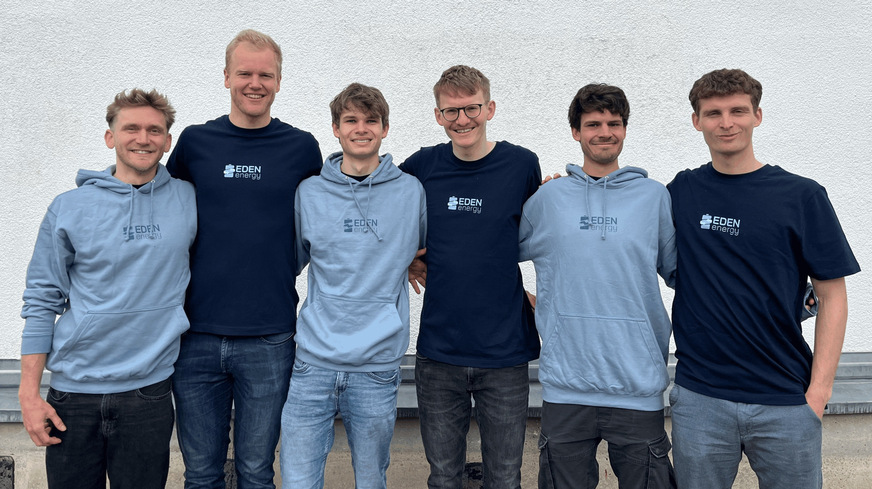
Fraunhofer ISE
State of health measures how much of its original capacity a battery has kept, and it is the key figure when deciding whether a used pack is still worth installing. On that measure, the packs EDENenergy has tested so far have performed far better than the company expected, meaning more usable capacity from each pack and more years of service before it needs replacing. What is more a storage cabinet is a far kinder place for a battery than a scooter. Once installed, the packs face much less vibration and fewer temperature swings than on the road, so the company expects them to give several more years of reliable service.
Swap as you go
EDENenergy monitors every module remotely and replaces packs one at a time as they reach the end of their life, without shutting the system down, before sending the retired batteries to recycling partners. The company argues this turns an apparent weakness of second-life storage into a technical advantage. Conventional manufacturers typically guarantee 80 percent of original capacity after ten years, while EDENenergy says module swaps can hold its systems at a constant 70 kWh over the same period.
Why today's quality decisions will shape 30 years of solar
From 70 to 300 kWh
The first systems are aimed at regional SMEs that already run PV but have no storage. EDENenergy also sees potential among municipal utilities for self-consumption, peak shaving and power trading. The team of three founders and three part-time staff now plans to scale systems up to 300 kWh and hopes to win more pilot customers. Regional businesses can have half the cost covered through Baden-Württemberg’s “Mittelstand trifft Start-ups” programme. EDENenergy is also backed by the Leistungszentrum Nachhaltigkeit and the state’s BW Pre-Seed programme, under which Ulrich Prediger, founder of bike-leasing company JobRad, became its first investor. (TF)