



Battery storage is usually judged by how much energy it can hold and for how long, and its role as a bridge between generation and consumption, absorbing surplus wind and solar power and releasing it when needed, will all remain important. Grid-forming batteries add a second question, which is how a system behaves electrically – both in normal operation and when the grid is disturbed. They can help to stabilise frequency and voltage, taking on functions traditionally associated with the generators in large power plants.
SolarPower Europe maps a route to 200 GW of storage
As more renewables connect to Europe’s grids, the European Commission is moving to make grid-forming (GFM) capability a requirement. Its draft revision of the Network Code on Requirements for Generators (NC RfG 2.0), published for public consultation in July 2026, proposes grid-forming requirements for certain non-synchronous generation and electricity storage modules. Between 2027 and 2029, EU member states are expected to update their national grid codes accordingly.
What does grid-forming actually mean?
Europe’s power grid runs at a frequency of 50 Hz, and deviations signal an imbalance between generation and consumption. While frequency is shared across a synchronously operated grid, voltage is shaped by local conditions and must stay within appropriate limits. Traditionally, the generators in large power plants have done much to keep both stable, as the kinetic energy stored in their rotating masses slows rapid changes in frequency. But as more electricity is fed into the grid through inverters, these stabilising characteristics need to be provided in other ways.
Conventional grid-following battery systems can already help. As well as absorbing energy when generation is high and releasing it when needed, they can provide frequency support by adjusting their charging or discharging power, and voltage support by absorbing or injecting reactive power. But they rely on an existing grid voltage and synchronise with that reference.
Europe has built the batteries, and now has to run them well
A grid-forming system works differently. It establishes and regulates its own voltage and frequency reference, so it does not depend on an external grid voltage and can help to stabilise both. A system designed for black start can also start up without an external power supply, allowing it to help restore the grid after a widespread power outage, for example. Sungrow implements grid-forming functions through the power conversion system (PCS) and its control algorithms, using the principle of a virtual synchronous machine, in which the converter control emulates selected dynamic characteristics of an electromechanical synchronous generator. This approach is now being tested in Belgium.
A glimpse into the future of utility-scale battery storage
In Vilvoorde, Belgium, ENGIE and Sungrow have built a battery storage project with 200 MW of power and 800 MWh of storage capacity, using 320 liquid-cooled PowerTitan storage units. The battery park was officially inaugurated in January 2026.
The system’s main purpose is to absorb surplus energy during periods of high generation and release it when demand is high. Alongside this, two generations of Sungrow’s battery storage systems, PowerTitan 1.0 and PowerTitan 2.0, are being integrated under a common control system, so that their grid-forming capabilities can be tested.
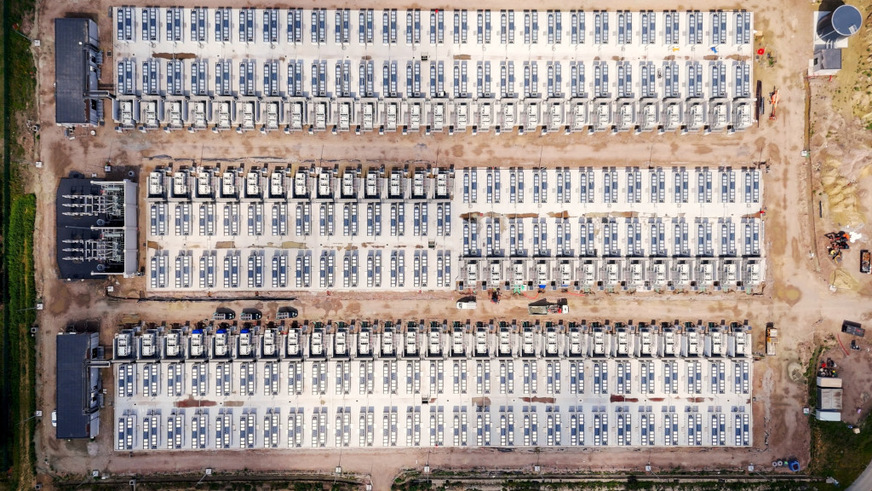
Sungrow | The Bik Picture
The site itself set limits too. Space in Vilvoorde is tight, so the challenge was to fit substantial storage capacity into a compact footprint without compromising safety.
Sungrow’s answer is a compact design with high energy density, in which the battery and PCS are integrated into a single AC block. Compared with a conventional DC block design, PowerTitan 2.0 needs half the footprint for the same energy storage capacity. Safety is built into the design from cell to grid, and Sungrow regularly conducts large-scale fire tests to check how well this safety architecture works.
Different countries, different requirements
Priorities differ from country to country, Sungrow finds. In Belgium, Vilvoorde highlights integration within a limited footprint, operation under a common control system and testing of grid-forming functionality. In the UK, the stability market is creating opportunities for battery energy storage systems to provide services such as reactive power and inertia support. In Germany, Sungrow sees the priorities as the role of battery storage within the interconnected European grid, rapid responses to grid disturbances and support for grid restoration, including black start.
Sungrow's Andrea Polini: "Bankability counts more than price"
That raises the question of which services each power system actually needs, and how those requirements are set. Answering it will take close dialogue between technology providers, energy companies, grid operators and the research community. Sungrow has more than 900 employees, over 25 local offices across Europe and research and development centres in Munich and Amsterdam, which allows it to combine local knowledge with global technology. For Europe, the task now is to translate the needs of each grid into technical requirements and put the right rules in place.
Grid benefits need economic value
Grid stability services, particularly inertia and voltage support, also need to be paid for. The proposed network code revision and the national updates due between 2027 and 2029 will set the technical requirements, but operators will also need appropriate remuneration to make providing these services worthwhile. Grid-forming batteries can play their full part once technical design, local requirements and economic incentives line up. (James Li/hcn)