



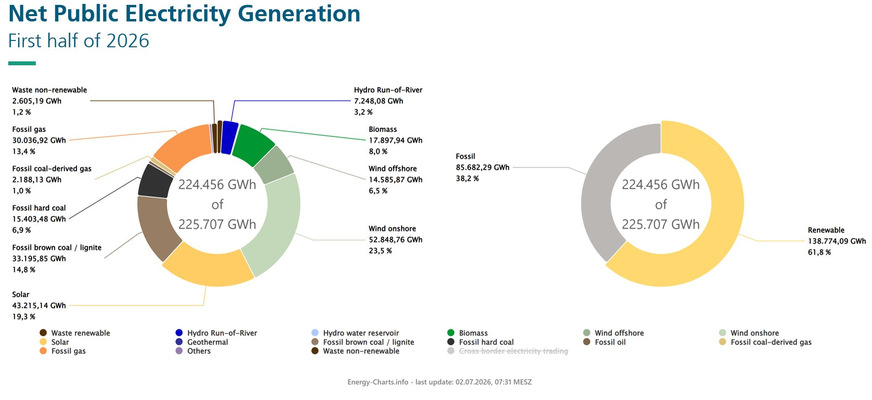
Germany's electricity mix leaned further towards renewables in the first half of 2026, with solar delivering a record feed-in of 43.2 TWh, according to an analysis by the Fraunhofer Institute for Solar Energy Systems (ISE), based on data from the energy-charts.info platform. Renewables accounted for 61.8 percent of net public electricity generation over the period, broadly in line with the 61.3 percent recorded a year earlier, while strong output from wind and solar kept electricity prices largely decoupled from a gas price spike triggered by the war in Iran.
Using less energy emerges as a public-friendly climate strategy
Fraunhofer ISE
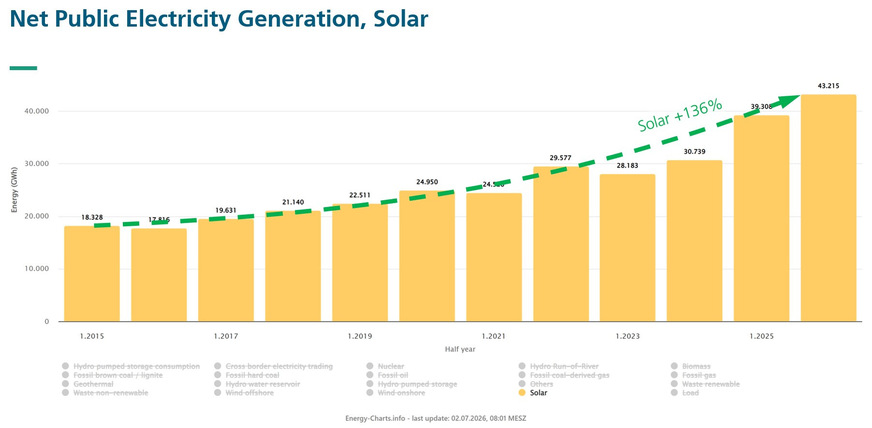
Photovoltaic feed-in rose ten percent year on year, from 39.3 to 43.2 TWh, a new high for Germany, and generation across the EU as a whole also reached record levels, up 254 percent since 2015. Wind performed strongly too: offshore generation climbed from 11.4 to 14.6 TWh, itself a record, while onshore output rose from 48.7 to 52.8 TWh, lifting wind's share of net public generation from 28.8 to 30 percent. Hydropower and biomass both eased slightly, with hydropower falling to its lowest level since 2015, while generation from natural gas, lignite and hard coal rose six percent to 78.6 TWh. Factoring in consumption and transmission losses, the renewable share of load reached a record 58.5 percent, up from 55 percent.
Fraunhofer ISE
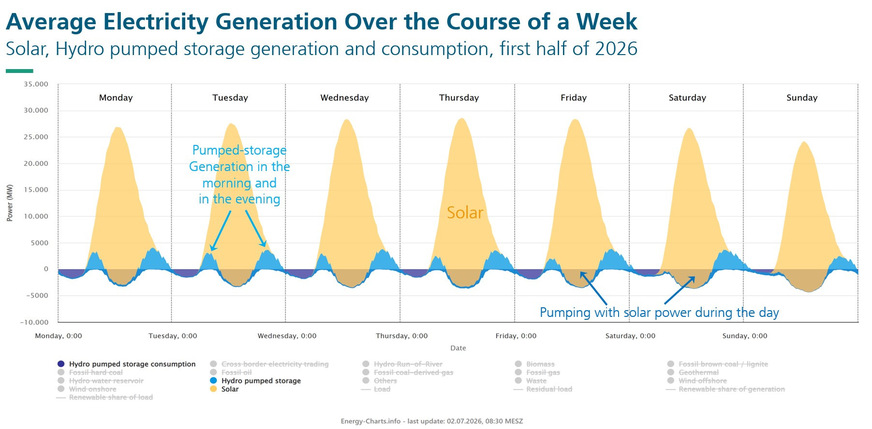
The growing volume of wind and solar on the grid is pushing day-ahead electricity prices towards zero for more hours of the year, as plants increasingly curtail output when prices turn negative. Battery storage capacity grew from 25.4 to 29.3 GWh, with more large-scale systems commissioned in the first half of 2026 than in the whole of the previous year, though Fraunhofer ISE points to a persistent "storage gap" limiting the extent to which surplus generation can be shifted to periods of lower output. A June heatwave illustrated the stakes, pushing up cooling demand just as conventional plants ran at reduced capacity, and driving sharp price swings in the evening hours.
Fraunhofer ISE
Germany's reliance on imports fell sharply, with net imports of just 1.3 TWh, compared with 9.6 TWh a year earlier. On the deployment side, 6.7 GW of new photovoltaic capacity was added in the first half of the year, split between building-mounted systems up to 30 kW (2.1 GW), the 30–100 kW segment (1.1 GW) and ground-mounted installations, which contributed the largest share at 3.5 GW. Total installed module capacity rose to 124.9 GW, with inverter capacity reaching 113.9 GW. A joint analysis by Agora Energiewende and Fraunhofer ISE cautions that changes under discussion as part of the EEG amendment could undermine the economics of smaller rooftop systems specifically, potentially encouraging installers to scale down designs or leave available roof space unused.
Solar cuts EU gas bill by €20 billion during Middle East war
The Trump effect
The price effects of the Iran war were stark. Gas prices rose 48 percent between February and March, pushing the marginal cost of gas-fired generation up 39 percent to €132.87 per MWh. Had gas plants set the price under the merit-order system, electricity costs would have risen sharply in step. Instead, the exchange price fell to €95.58 per MWh as low-cost renewables pushed prices down, before falling a further 27.7 percent in April against a 12.6 percent decline in gas prices. "If renewable energy sources hadn't contributed so heavily to electricity generation, the electricity price on the exchange would have been 76 percent higher in April," said Energy Charts project manager Leonhard Gandhi. (TF)