



Commercial vehicle depots are quietly becoming one of the most interesting application fields for battery energy storage systems (BESS), charging infrastructure and energy management software (EMS). Three presentations at a well-attended session of the Intersolar Forum, delivered by iwell, Sungrow and coneva, show how charging infrastructure, on-site storage and dynamic electricity market participation are converging into a single commercial proposition for logistics operators.
The underlying challenge is consistent across the sector. Heavy-duty electric trucks and buses require substantial charging power, often well beyond the firm grid capacity available at depot sites. Operators face rising electricity costs, tightening Zero Emission Zone requirements between 2025 and 2030, and the need to future-proof investments without waiting years for grid reinforcement. Storage and intelligent control have emerged as the practical answer.
Sungrow: a one-stop hub at Schiphol
At Schiphol Airport, Sungrow has delivered an integrated charging hub for logistics operator R. Nagel B.V., developed jointly with charge point operator Schouten Energy. The site provides 900 kW of charging capacity for eight heavy-duty trucks simultaneously, combining one IDC480E and two IDC180E DC chargers with six PowerStack battery units.
Businesses drive e-mobility at Amsterdam charging summit
Lance Hong, Key Account Manager EV Charging of Sungrow reported commissioning within three days, cost savings of around 50 percent through the one-stop approach, and an internal rate of return of 24.86 percent with a payback period of just over four years. Annual charging energy reaches 214.8 MWh, supported by 299.2 MWh of battery throughput. The revenue model combines solar self-consumption, peak-valley arbitrage, day-ahead and imbalance market participation, and Dutch tax incentives including the Energy Investment Allowance.
iwell: orchestrating non-firm grid connections in Amsterdam
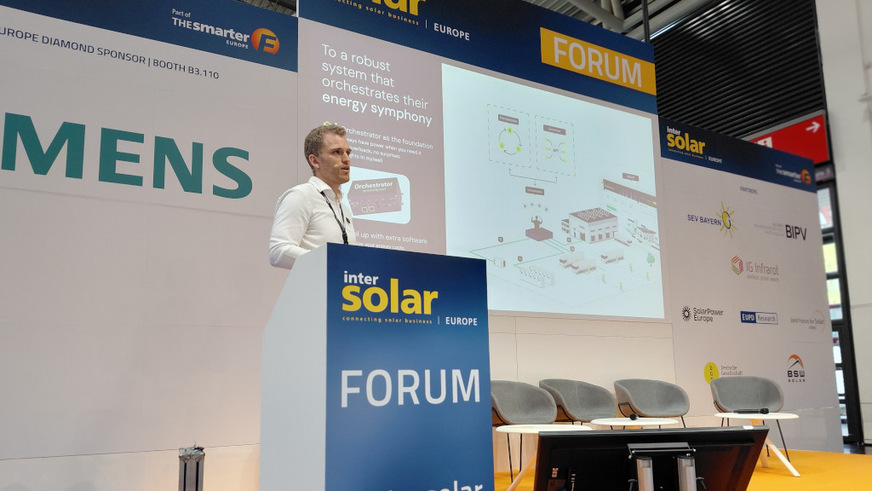
Dutch provider iwell, founded in 2016 and now operating across the Netherlands, Germany, the United Kingdom and Belgium, has deployed its 3 MW/6.45 MWh BESS, 2.2 MW rooftop PV and EMS combination at two Egged Bus Systems (EBS) depots in the Amsterdam area, each charging 200 electric buses. The sites operate under non-firm grid connections, with periods of zero import during winter days and multiple transformers introducing dynamic local limits.
Dutch grid resilience offers lessons for Europe
According to Michael Auf dem Berge, head of iwell's Commercial, Community and Industrial Energy Solutions unit, the EMS performs multi-level peak shaving, manages dynamic limits behind each transformer and bridges low-grid-power periods through optimised charge schedules. The company complements its hardware and software offering with commercial modelling, sales training through its iwell Academy and full O&M support, positioning itself as a partner across the project lifecycle.
H.C. Neidlein
coneva: turning price volatility into margin
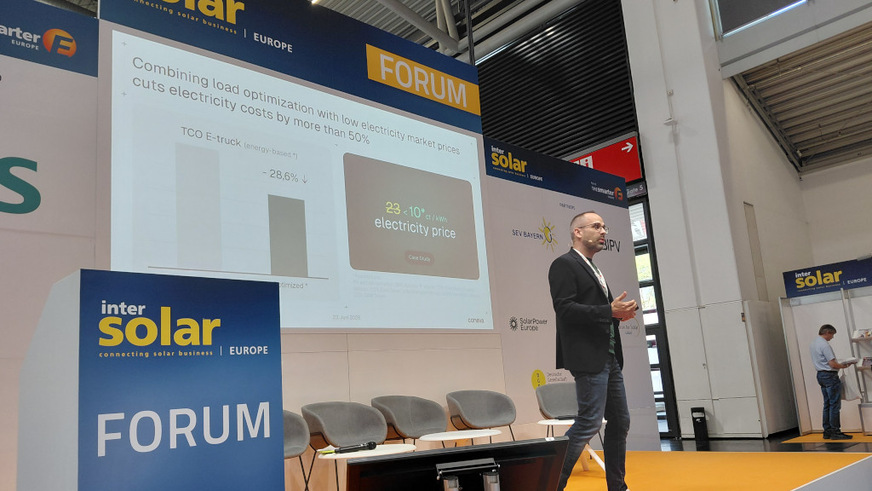
Munich-based coneva approaches the same challenge from the market side. Speaking at the Intersolar Exhibition Forum, CEO Frank Blessing argued that electricity is the dominant cost driver at depot operations, and that exposure to the 96 daily EPEX spot price intervals can be reframed as opportunity rather than risk.
Through its Flex platform, coneva combines load shifting, battery dispatch and trading across the day-ahead, intraday auction and continuous markets. Long dwell times allow overnight charging at low prices, while shorter dwell windows are bridged by BESS capacity. Unused storage can generate additional revenue through market participation.
Combining PV self-consumption of around 22 percent cost reduction, trading gains of 11.5 percent and load management under §19 StromNEV worth 23 percent, coneva claims total electricity cost reductions exceeding 50 percent. The company, active in 17 countries with more than 6,000 charging points under management, positions itself as energy supplier, direct marketer and technology provider in a single offering.
H.C. Neidlein
A converging commercial model
Taken together, the three approaches presented at Intersolar Forum in Munich and moderated by Hans-Christoph Neidlein of pv Europe, point to a maturing model in which depot electrification is no longer a grid problem to be endured but an integrated energy business to be optimised. (hcn)