



CATL used this year's Intersolar Europe and ees Europe in Munich to unveil the sodium-ion version of its TENER battery energy storage system, alongside a battery-buffered fast-charging product for EVs. The launch, held on the sidelines of the Smarter E expo, marked the company's first large-scale sodium-ion product for markets outside China.
The system on show in Munich is a 42 tonne unit that allows a 1 GWh project to be assembled from just 34 modules, a step up from the smaller containerised sodium-ion unit CATL had previewed at SNEC in Shanghai earlier this year. William Xu, director of CATL's energy storage system technical centre, said the company has shipped more than 300 GWh of lithium-ion systems to date, and positioned sodium-ion as the next stage of that development rather than a replacement for it.
IEA: Middle East crisis driving investment in electrification
Amanda Xu, CATL's energy storage CTO and president of its European ESS business, said the system had been built around three priorities for asset owners: flexibility, operational stability and availability. Its 30 MWh-plus scale is designed to simplify project deployment, while a decoupled energy and power block design allows discharge durations from one to eight hours at full rated power. Moreover, faulty modules can be isolated and replaced without taking the rest of the system offline.
Wider range, longer life
The sodium-ion cells offer a wider operating temperature range and higher overcharge tolerance than comparable lithium-ion systems, along with what CATL describes as greater intrinsic safety under abuse conditions. The company says the cells can reach up to 15,000 cycles at 25 degrees Celsius and more than 10,000 cycles at 45 degrees Celsius, figures first disclosed at SNEC. Amanda Xu acknowledged that customers would rightly ask whether the technology can scale and hold up over operating lifetimes of 20 years or more, calling those the right questions to ask given an industry that has never lacked strong laboratory results.
Tesvolt presents 500 kWh Powercore G2 storage for C&I
Initial shipments begin this September in China, under a 60 GWh supply agreement with system integrator HyperStrong, with CATL targeting 1 GWh shipped by the end of the year. Global shipments are due to start next June.
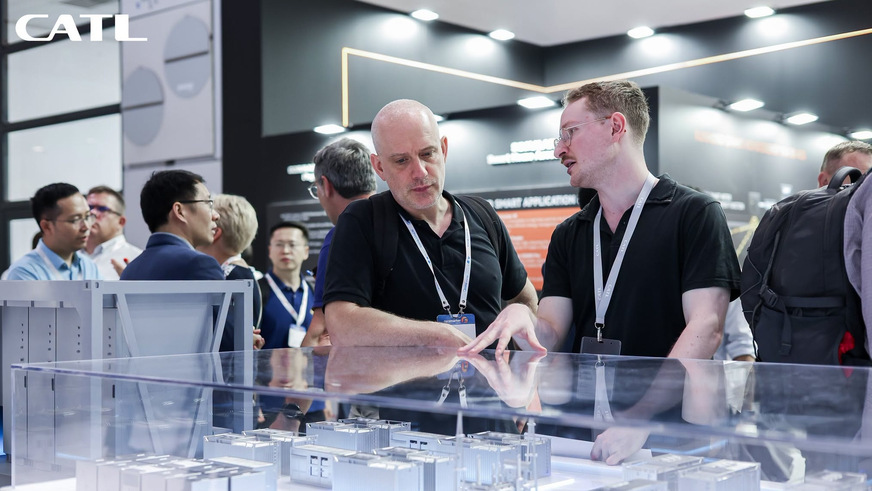
CATL
Cells everywhere on the show floor
CATL's cells also featured heavily elsewhere at the 2026 edition of the Munich show. Contemporary Nebula Technology Energy, an energy storage firm backed by CATL, used its own stand to launch two new commercial and industrial systems, the STAR H-MAX and STAR X, both built around CATL's 530 Ah lithium iron phosphate cells and rated for more than 10,000 cycles. Separately, CATL showcased its battery-buffered Turbocharger, an EV fast-charging unit that uses onboard storage to reach megawatt-level output without straining the local grid connection, a category also being explored by BYD's Flash Chargers at lower power levels.
Global solar installations hit record 664 GW in 2025
Visitors to several storage stands across the show floor reported CATL cells as among the most commonly used, alongside EVE Energy and Gotion. Caspar Spinnen, PR manager at CATL, put the company's approach plainly: "Right now, more is definitely more with regard to the expansion of battery storage." (TF)