



Four big solar schemes went before ministers last month and all four came away with consent. Together they add close to 2 GW, and every site includes a battery.
The government wants 45–47 GW of solar installed by 2030 under its Clean Power Action Plan, more than double the 21.6 GW in place at the end of 2025. Its Solar Roadmap expects large-scale projects to deliver around 60 to 65 percent of that capacity. In England, any scheme above 100 MW has to win consent through the nationally significant infrastructure project (NSIP) process, where ministers make the final call. The four decisions taken in October give a clear picture of how those projects are now being designed.
Great North Road – the largest of the four
Elements Green’s Great North Road Solar and Biodiversity Park, north-west of Newark-on-Trent in Nottinghamshire, received consent on 27 October. It is the biggest of the four, and Solar Power Portal ranks it alongside the 800 MW Springwell scheme as the joint largest solar project yet consented in the UK. The plant pairs around 1.12 GW of DC capacity with an 800 MW import and export connection, a DC/AC ratio of about 1.4, and adds a 440 MW/880 MWh battery to use that connection more fully. Elements Green models annual generation at around 1.1 TWh and expects to start construction in 2027. The site will connect at Staythorpe substation, where the developer has also secured planning permission for a separate 360 MW/720 MWh battery.
Steeple – building on a closed coal plant’s connection
Further north in the same county, RES secured consent on 9 October for the Steeple Renewables Project at Sturton-le-Steeple. The scheme combines around 450 MW of solar with around 150 MW of battery storage and will use grid capacity freed up by the closure of the neighbouring West Burton coal-fired power station. RES has said construction could begin in 2027 and take about two years.
UK – along the River Trent, solar inherits the grid from coal
For the villages around the site, RES plans a community benefits package worth £320,000 a year, or around £13 million over the project’s 40-year lifetime. It is also looking at bringing in its Local Electricity Discount Scheme, which on current indicative figures would take at least £350 a year off the electricity bills of homes and businesses within 1 km of the panels. The final figure is still to be agreed with the community and will reflect the capacity eventually installed, and RES stresses that community benefits are kept separate from the planning decision.
Island Green Power
Green Hill – the most storage
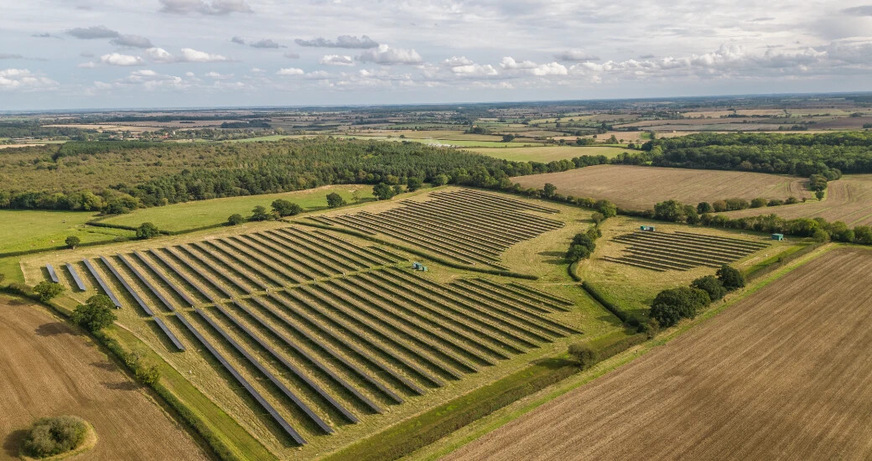
Island Green Power’s Green Hill Solar Farm, approved on 8 October, goes the furthest on storage. The panels and battery are spread over nine sites covering around 1,200 hectares in Northamptonshire and Milton Keynes. Together they can export up to 500 MW to the grid, and the battery alone is rated at up to 500 MW. Underground cables will link the sites to National Grid’s Grendon substation, and around 228 hectares are set aside for environmental mitigation and habitat improvements. The decision gives the developer its third consented solar NSIP, after Cottam and West Burton Solar.
Frodsham – the smallest
The smallest of the four, and the only one in the north-west, is Cubico’s Frodsham Solar on Frodsham Marsh in Cheshire, which won consent on 27 October, the same day as Great North Road. Published figures for its solar capacity range from 100 MW to 150 MW, and Cubico has a connection agreement with SP Energy Networks to export up to 100 MW at the existing Frodsham substation. The scheme also includes an integrated battery, and Cubico’s 2025 funding statement put construction costs at around £80 million.
Storage as standard
All four of the newly consented schemes includes battery storage, and at least three will connect at existing substations, at Staythorpe, West Burton and Frodsham. Co-located storage captures generation above the export limit around midday and shifts it into the evening peak. That justifies a larger array, and Great North Road has the largest, with around 1.12 GW of panels behind an 800 MW connection.
Next stop, the grid
Planning consent is just the first of several hurdles. The four projects still need firm connection dates under the reformed grid queue and a buyer for their output, whether through a CfD or a private power purchase agreement. For those bidding into the CfD scheme, the next date to watch is 19 November, when NESO publishes the AR8 Notice of Auction and DESNZ sets the budget. (TF)