



In a Brussels meeting room in October 2017, a few hundred buyers and suppliers sat on opposite sides of an aisle, trying to work out how a corporate power deal could work at all. Lawyers were unsure, and lenders even more so. Nobody in the room would have described what they were doing as a market.
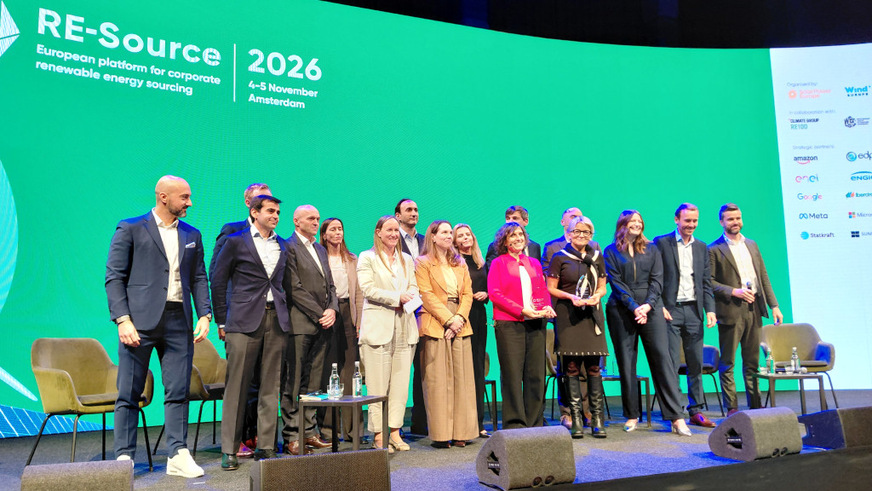
Nine years on, 1,400 delegates gathered at the Beurs van Berlage in Amsterdam on 4 and 5 November for the tenth RE-Source. Over that time, European corporate renewable power purchase agreements (PPAs) have grown from roughly 3 GW signed in the platform’s first four years to around 60 GW of cumulative volume, and in 2024 wind and solar together outproduced fossil fuels in the EU for the first time. Even so, the mood in Amsterdam was more reflective than celebratory.
A market cooling just as Europe needs it most
Europe’s contracted renewable capacity through corporate PPAs reached 5.9 GW in the first ten months of 2026, down 9.7 percent on the same period a year earlier, which goes some way to explaining the restraint. The market is heading for a second annual decline even as gas prices climb again and the European Commission’s Electrification Action Plan, adopted in July, aims to double the electrification rate to 46 percent by 2040.
Too much sun at noon
As delegates heard repeatedly, more frequent zero and negative price hours are eroding capture rates for solar, the technology that drove the last wave of PPA growth, cutting the average price its output actually earns. In Spain, roughly 920 zero or negative price hours had occurred by early November, most of them in solar hours. Silvia Escudero, head of upstream origination for Iberia at Statkraft, said that depending on grid constraints, generators can lose between 35 and 50 percent of their solar output to economic or technical curtailment. “For an investment case, that is horrible,” she said.
Rising gas prices push PPA buyers towards operational assets
The pain extends to buyers. Those who signed pay-as-produced solar PPAs at the height of the boom now find themselves over-hedged at midday against a baseload consumption profile, with too much power to sell back cheaply in the middle of the day and too little cover in the expensive evening hours.
Grids first
The firmest point of agreement over the two days was that the single-technology, pay-as-produced PPA has reached the limits of what it can do, and that the grid sits at the heart of the problem. “Everything starts and ends with the grid,” said Malgosia Bartosik, deputy CEO of WindEurope. Around 500 GW of renewable projects are stuck in European connection queues, more than Europe’s entire operating wind fleet, and grid congestion cost the system €9 billion in 2024 alone.
Enter the hybrid
The industry’s answer is to move from single projects to portfolios, and from buying volumes of energy to buying a delivery profile that matches demand. Hybrid PPAs combining solar, wind and battery storage featured in every panel, and around a quarter of the requests for proposals (RFPs) run through LevelTen’s European platform in the third quarter of 2026 drew hybrid offers, according to Max Plumptre, the company’s director of European transactions.
Hybrid parks: why PV and wind rarely share a single connection
How a hybrid battery is set up, and who pays for its grid access, decides much of its value. A standalone battery in France now carries grid fees of roughly €50,000 per MW per year, higher than its annualised capital cost, according to Domenico Franceschino of Axpo. Co-located “green” batteries, charged only from on-site solar, avoid those fees but forgo perhaps €45,000 of annual revenue per MW, he said, compared with roughly €80,000 for a fully flexible standalone system. “Grey” hybrids, able to charge from the grid, often win on paper but in markets such as Germany frequently cannot get a permit.
The contract has to settle who controls the battery, who keeps the extra revenue from intraday trading and ancillary services, and who bears the cost of cycling and degradation. “The price is two lines, but everything else is where the deal is really won or lost,” said moderator Thomas Schied of aream.
Hans-Christoph Neidlein
Buyers on the move
Among industrial buyers, the pace of change varies. Rønnaug Sægrov Mysterud of Norsk Hydro, named Europe’s top industrial PPA buyer at the first RE-Source awards, said aluminium producers remain highly price sensitive and depend on indirect carbon cost compensation to keep investing. Rockwool has moved faster. Kenneth Dupont described a decisive shift away from single-technology deals, with a hybrid PPA signed in Poland and a request for quotation (RFQ) in Romania that settled on a combined structure. His rule of thumb is never to contract 100 percent of consumption through a single PPA.
S&P Global: batteries beat gas and diesel on data centre costs
Data centres bring their own demands. Google has 1.5 GW of clean power under contract in Europe, and in September it announced a PPA with Fortum tied to extending the life of Finland’s Loviisa nuclear plant, which supplies around 10 percent of the country’s electricity. Microsoft, Amazon, Google and others at the event argued for a system-wide view of flexibility that does not assume every flexibility resource must sit on the data centre’s own site.
For retailers spread across many markets, the hurdles look different. Jacob Wædeled Smedegaard of the Lars Larsen Group, owner of the Jysk retail chain, described 18 months of internal preparation before a four-month negotiation produced the group’s first physical PPA, in Denmark. The group consumes roughly 200 GWh a year spread across more than 20 European markets, so most of its sites are too small for a physical deal. To cover them, the group is exploring ways to pool its demand with other buyers.
Brussels’ to-do list
Policymakers face pressure of a different kind. Paula Rey García of the European Commission and policy officer José Elias Cabrera set out a dense agenda: finalising the Grids Package by the end of the year, implementing the Electricity Market Design reform, supporting storage through the tripartite contract initiative, building hybrids into the Electrification Action Plan, and preparing the post-2030 climate and energy framework. The Commission’s recommendations from the summer on removing barriers to PPAs identified regulatory gaps on permitting, risk, accounting and standardisation, as well as non-regulatory problems such as buyer creditworthiness and a persistent lack of transparency.
Several speakers pushed for faster action on specific bottlenecks: guarantees of origin for storage, still issued in only a handful of European countries; recognition of PPAs within the EU ETS Investment Booster; and the long-standing difference between the international (IFRS) and US (GAAP) accounting rules for virtual PPAs, which Dupont argued is single-handedly holding back virtual deals in Europe.
The next ten years
Asked by Annie Scanlan, managing director of the RE-Source Platform, what the next ten years would bring, panellists converged on a handful of themes: electrification as the central organising principle; a shift to portfolios of assets; hourly matching of clean supply with demand; and flexibility treated as a responsibility shared across the whole system.
Buyers chasing value, not price, in Europe's PPA market
Nikola Gazdov of Sunotec offered an encouraging data point from Bulgaria, where rapid battery deployment over the past two years cut negative price hours by almost 70 percent in the third quarter of 2026, even as solar output rose by 35 percent. “Negative hours are a snapshot of history, not a tendency,” Dries Acke of SolarPower Europe added. The technology has arrived since that first meeting in Brussels, and whether Acke is right across the continent now depends on how quickly grids, permits and contract structures catch up. (hcn)