



Photovoltaics is now Croatia's fastest-growing electricity source, though not yet fast enough to close the gap left by shrinking hydropower output. According to the Croatian Renewable Energy Association (OIEH), 218 MW of new solar capacity was connected to the grid in the first six months of the year alone, pushing solar's share of the electricity mix steadily higher.
13 percent from the sun
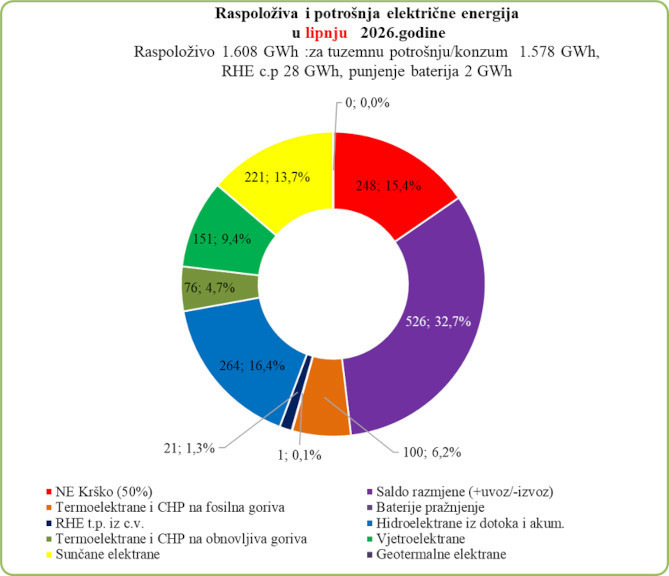
The figures show that 221 GWh of solar electricity was fed into the Croatian grid in June this year. That accounts for 13 percent of total electricity consumption in the period, which stood at 1,608 GWh. After hydropower and Croatia's half share in the Krško nuclear power plant in Slovenia, photovoltaics is now the country's third-largest source of electricity in summer, aside from the substantial imports on which Croatia still depends.
Stay informed on the solar energy transition – subscribe to our free newsletter
OIEH
A persistent supply gap
This points to a significant gap in the country's electricity self-sufficiency. In June alone, Croatia imported 526 GWh of electricity, mainly from Bosnia-Herzegovina and Hungary, making foreign suppliers the country's single largest source at 32.7 percent of consumption for the month.
Croatia still lagging on PPAs as barriers persist
The main driver is climate change, which is hitting Croatia hard: hydropower delivers strong output during the wet winter months, but generation drops sharply in spring and summer. Solar output rises over the same period, though not quickly enough for photovoltaics to offset the decline, leaving Croatia dependent on electricity imports, OIEH warns.
Without further renewables expansion, imports will continue
Croatia has otherwise had a good year for domestic electricity supply, even managing net exports earlier on. But OIEH cautions this was down to unusually favourable hydrological conditions, and won't be sustainable without new renewable capacity, storage systems and additional system flexibility.
Renewables cover 44.2 percent in summer
Change is now urgently needed, even though Croatia's current position remains comparatively strong. In June, the country met 44.2 percent of total electricity consumption from its own renewable sources: hydropower still contributed 16.4 percent despite the sharp seasonal decline, followed by photovoltaics at 13.7 percent, wind at 9.4 percent and bioenergy at 4.7 percent, with the remainder coming largely from geothermal sources. This confirms that solar and wind are playing an increasingly important role in domestic generation during the summer months, representatives of the renewables association in Zagreb emphasise.
Shared energy, tangled rules: Croatia's community model falters
Peak load rising sharply in summer
This becomes all the more important as electricity consumption is set to rise alongside increasingly hot spring and summer months. The trend was evident on 30 June, Croatia's hottest day on record, when electricity consumption reached 70,348 MWh and peak load hit 3.689 GW, a new record for the Croatian grid. According to OIEH, daily consumption during hot spells rises by around 1,500 MWh per degree Celsius above average, while peak load increases by roughly 79 MW.
Even so, Croatia is on a reasonable trajectory, as long as hydropower continues to deliver. Thanks to strong water availability, renewables remained the country's most important domestic source in the first half of the year, supplying 79 percent of all electricity generated and meeting 58.4 percent of total consumption.
Croatia to launch €38 million rooftop solar programme
This underlines the extent of Croatia's dependence on imports: bringing in almost one TWh in the first half of the year highlights the need to accelerate the expansion of new renewable capacity, OIEH stresses. Net electricity exports of 332 GWh were recorded in January and February, but net imports from March to June reached 1,325 GWh, leaving the trade balance for the first six months of 2026 at a net 993 GWh in imports.
Accelerating the solar rollout
OIEH warns that photovoltaics is not growing fast enough at current pace to reduce reliance on electricity imports. According to its estimates, Croatia would need to accelerate solar construction to around 50 MW per month, with some 2.4 GW of new capacity required over the next four years to cover current summer import requirements. (su)