


How is business at Fronius right now?
Business is going well again. We generated a profit in 2025 and are winning back market share. For 2026, we are cautiously optimistic. After the 2023 restructuring, when we had to scale back capacity and cut around 1,000 jobs, that painful phase is now behind us. We are on stable ground again and have new products on the market. Feedback on Reserva Pro, our European-made batteries, is very positive.
How is capacity utilisation looking right now?
Our annual inverter production capacity in Europe stands at 10 GW and is currently running well below that level. We are not fully utilised because we invested heavily in capacity in recent years. Under the right conditions, we could rebuild the necessary infrastructure and workforce within about a year to scale up to 17 GW.
Where do you manufacture?
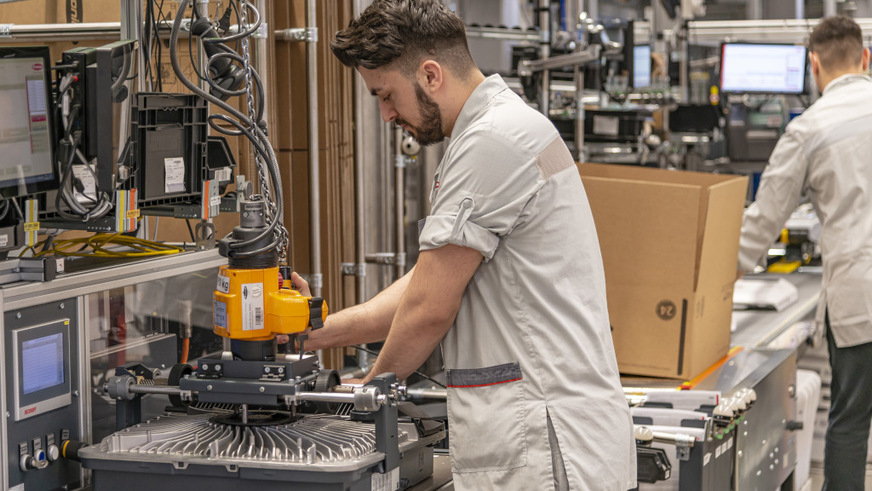
Our plant in the Czech Republic produces components and sub-assemblies, which are then assembled into finished products at our headquarters in Upper Austria. All Fronius inverters are 100 percent Made in Europe, with a very high share of European value creation.
How strong is the European inverter industry overall?
According to S&P Global and figures from the European Solar Manufacturing Council (ESMC), more than 100 GW of inverter production capacity is available in Europe. That is very significant, more than the entire annual European market, which stands at around 60 GW. Compared with module, cell or battery production, the European inverter industry remains structurally strong. Utilisation across all manufacturers is well below capacity, meaning the sector could ramp up quickly to meet demand.
Do you welcome Chinese manufacturers setting up assembly lines in Europe?
If it is only the final assembly step, it is often a fig leaf. Final assembly accounts for less than five percent of total value creation. It does not strengthen European supply chains, employment or energy security. If it creates the impression that the products are actually made in Europe, that is misleading, because the pre-assembled components themselves are not manufactured here.
The EU has classified certain countries as high-risk. Does this classification make sense?
Yes. The European Commission has defined this very clearly: a country is classified as high-risk when politically directed cyberattacks against Europe have been documented and officially reported by at least one EU member state or by the Commission itself. Four countries currently meet these criteria. This is not a politically motivated label but a response to concrete, verifiable incidents. Such classifications can change if the threat landscape shifts.
Solar Investors Guide #7 – Hackers highlight solar infrastructure risks
Why has cybersecurity become such a central issue for inverters?
Inverters are part of critical infrastructure. They can be remotely controlled, updated and, in principle, switched off. In a geopolitical crisis, that creates a real vulnerability. We have been pointing this out for years. Until recently, the usual response was that such scenarios seemed unlikely, but this perception has changed fundamentally in 2026. When military escalation is no longer an abstract idea, the question of who controls the energy system becomes very concrete.
Is cybersecurity really a central purchasing criterion in practice?
It is not the single most important argument, but it has steadily gained weight. Customers are increasingly choosing Fronius deliberately, even though we are more expensive than many Chinese competitors, because they want a manufacturer they can trust. In politics, particularly in Brussels and in several member states, energy security and the protection of critical infrastructure have moved to the centre of the debate.
How should cybersecurity be understood in this context?
There are two dimensions. The first is technical cybersecurity, which all products must meet under the Cyber Resilience Act and related regulations. The second is the non-technical risk profile: the trustworthiness of the supply chain and the ownership structure behind a product. Both matter, and in practice they cannot be separated. Secure products require trustworthy supply chains, which in turn require industrial capacity in trustworthy countries.
Does storing data on local cloud servers in Europe solve the problem?
No. The physical location of a cloud does not determine who holds access rights. Master access always remains with the manufacturer, otherwise remote maintenance and software updates would not be possible at all. Storing data in Europe is important for GDPR compliance, but it does not restrict external access options. This is a widespread misconception.
What exactly does the new EU funding restriction cover?
Projects connected to the European grid and financed through the European Investment Bank must comply with the requirements from 1 November 2026, with transitional rules for projects already in planning. For EU-funded projects outside Europe, the deadline is 15 April 2027. In practice, this currently affects utility-scale projects above all, and thus around 15 percent of the European market. It is not a ban, but a restriction on public funding for products from high-risk supply chains. A clear challenge is the absence of formal written guidance: the details have so far been communicated mainly to financing banks rather than published transparently. Written clarity would be very helpful for the entire industry.
Fronius International
Would broader Made-in-Europe requirements make solar projects significantly more expensive?
No. Independent analyses show that European-made inverters increase overall system costs by two to four percent for smaller installations, and even less for utility-scale projects. At component level, the price difference can be up to 50 percent, but at system level the effect is in the low single-digit percentage range. That is a reasonable price for European security, resilience and value creation. Austria already applies a Made-in-Europe bonus, which also requires printed circuit board assembly to take place in Europe, not just final assembly. That is a significant step.
A boom decade ahead for PV investment
Would the industry be able to scale up quickly if demand continues to rise?
Yes. Fronius could expand capacity to 17 GW within a year. Across Europe, more than 100 GW of inverter production capacity is already available. The labour market has shifted back in favour of employers, so recruiting skilled workers in Upper Austria is realistic again. Clearer framework conditions would also unlock scale and automation effects, making European products increasingly competitive on price.
How are the recent US import restrictions on Chinese-made inverters affecting Europe?
The measure affects all inverters not manufactured in the US, not only Chinese ones. New product generations require an exemption from the Federal Communications Commission (FCC), which involves detailed disclosure of ownership structures, supply chains, software control and remote access options. Manufacturers must also submit plans for future US production. The reasoning is national security. It is a logical and consistent decision. For Europe, it means that global overcapacity will increasingly be redirected to our market. Europe must therefore act quickly with further measures to safeguard its industry and energy security.
Interview by Hans-Christoph Neidlein
See also our upcoming interviews with SolarEdge and Sungrow, plus accompanying background pieces.