



The analysis shows that long-term contracts provided support to EU businesses and households after the 2022 energy crisis, even as these mechanisms have begun to face headwinds.Amid renewed pressure on fossil energy markets and the pace of solar deployment in the EU, the report stresses the need to maintain continuity for auctions and PPAs, according to the association.
“EU leaders are looking for effective ways to enhance energy price competitiveness and shield Europe from yet another fossil fuel price crisis. They already have proven solutions in the form of corporate PPAs and auctions which award contracts for difference. It's now more crucial than ever that Europe boosts industrial electrification and access to PPAs, while also ensuring that auctions are well-designed to avoid missed opportunities and undersubscription. One clear short-cut is making sure that storage is properly integrated across these two vital solar routes to market,” said Dries Acke, Deputy CEO at SolarPower Europe.
Italy – Energy Release 2.0 secures 22.5 TWh for energy-intensive industry
The “Auctions and Corporate PPAs: European Market Review 2025” report examines the first half of the 2020s, when early years were marked by structural barriers to solar auction performance. Solar auction volumes peaked at 14.8 GW in 2021 before declining in 2022–2023, reflecting shortcomings in auction design across EU countries. Higher equipment costs linked to the energy crisis were not matched by ceiling tariffs, while technology-neutral schemes, lengthy administrative processes and complex non-price criteria further weighed on performance.
Half of auction rounds attracted bids below capacity
After 2023, solar auctions rebounded, with a record 25.2 GW of solar installed through auctions and tenders in 2025, up 23 percent from 2024 and marking a new high. The recovery reflects improvements in auction design. However, further changes are needed. Between 2021 and 2025, nearly half of EU auction rounds were undersubscribed, with bids below available capacity, pointing to missed opportunities to accelerate solar deployment.
Subcribe to your free monthly PV newsletter for investors
“To ensure that auctions can continue playing their growing role in driving solar deployment, EU policymakers should prioritise improving auction frameworks, supporting technology-specific tenders, providing long-term investment visibility, and considering energy storage in public support design,” said Simon Dupond, Senior Policy Advisor at SolarPower Europe.
SolarPower Europe
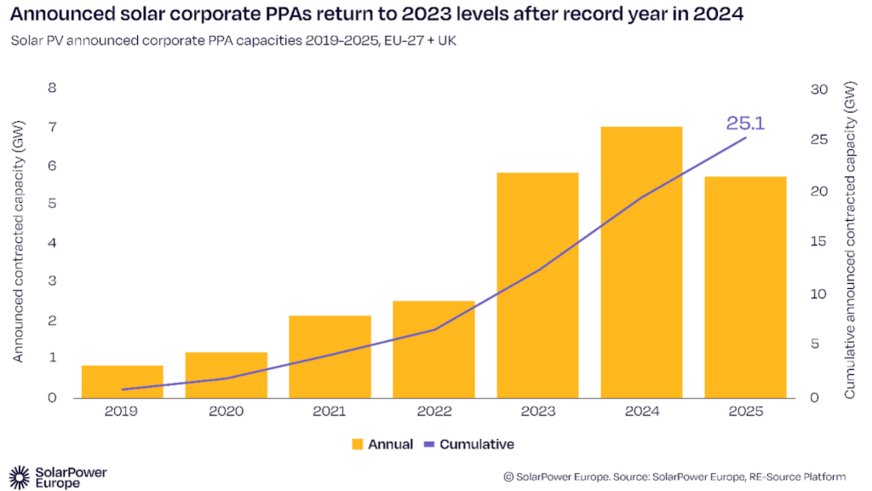
In the corporate PPA market, the trend differs. Following the energy crisis in 2023 and 2024, solar PPAs saw successive boom years. In 2025, however, announced volumes for solar PV corporate PPAs fell below the previous year’s record for the first time in several years.
PPA market conditions vary across Europe. In several countries, structural constraints including price cannibalisation, grid congestion and curtailment are weighing on uptake. Germany illustrates these dynamics, with signed solar corporate PPA volumes declining by 56 percent. As initial demand drivers have been largely exhausted, further growth in corporate demand for clean electricity at stable prices increasingly depends on new or newly electrified industrial users.
BayWa r.e.: “Co-located storage is a more complex challenge”
Spain remains a notable exception and continues to lead the European PPA market, with more than 2 GW of corporate solar PPAs signed annually between 2023 and 2025. Italy, Poland and Bulgaria have also recorded strong growth. These countries rely heavily on gas-fired generation and face comparatively high wholesale electricity prices, which is supporting PPA uptake.
Policy recommendations
The “Auctions and Corporate PPAs: European Market Review 2025” report sets out five policy recommendations to maximise the impact of solar PPAs and energy auctions on Europe’s energy security and competitiveness:
1. Ensure a level playing field between all routes to market
Solar project developers should be able to use PPAs or participate in energy auctions as suits their business needs. Regulatory frameworks should not exclude access to either financing strategy, and any effort that seeks to combine the two methods should be undertaken very carefully.
2. Tailor auctions and tenders to asset and system needs
Auctions in Europe should allocate as much renewable energy as possible. To avoid undersubscription, tenders should be technology-specific, enabling design that reflects the structural conditions and benefits of wind and solar. Resilience criteria should be applied without slowing deployment. Investors should be able to rely on transparent forward planning and auction schedules. Smaller installations below 1 MW should remain exempt from mandatory tendering requirements.
3. Integrate energy system flexibility in long-term hedging contracts
The growing frequency of negative price hours, rising curtailment and increasing grid congestion are mounting pressure on the design of renewable support schemes and on the appetite for private long-term agreements. Addressing these challenges can be achieved without undermining investment certainty through unnecessary or distortive market interventions. The fast-track solution is ensuring that energy storage, particularly battery storage, is recognised and integrated under PPAs and auction frameworks.
4. Ensure fair treatment of PPAs in EU carbon accounting rules
EU carbon accounting methodologies must recognise market instruments used in corporate energy procurement as a route to decreasing carbon footprints. The EU should ensure there is a uniform approach to measuring the carbon footprint of a product, starting with EV batteries and PV modules, which recognises clean and renewable power purchase agreements and guarantees of origin.
5. Boost electricity demand with electrification across all sectors
Electrification rates in the EU are stagnating, leaving the majority of energy consumption still reliant on burning fossil fuels, including many industrial processes. A comprehensive EU electrification strategy must tackle economic and regulatory barriers hindering industry electrification, including a fairer and more competitive tax regime for electricity. (hcn)