



As demand from heavy-duty electric transport grows, the shift from the Combined Charging System (CCS) to the Megawatt Charging System (MCS) is pushing infrastructure beyond the limits of conventional fast-charging technology. Fraunhofer ISE and its project partners have been addressing that gap at system level, combining grid-side rectifiers, modular high-frequency DC/DC converters and a high-current contact system. The consortium includes Motion Control & Power Electronics, STS Spezial-Transformatoren Stockach, Mercedes-Benz Energy and Fraunhofer IVI.
Corporate fleets drive EV demand as operating costs drop up to 50 percent
“Our project has focused on upgrading existing fast-charging infrastructure based on combined charging to the megawatt system. The higher charging power poses new challenges for power electronics, the contact system and grid connection capacity,” says Stefan Reichert of Fraunhofer ISE, who coordinated the project.
Second-life EV batteries as buffer
The integration of second-life EV batteries as buffer storage is a central element of the project. In the demonstrated setup, a 500 kW grid connection supported more than 1 MW of charging power, with the storage system supplying the difference, reducing peak grid load while maintaining high output.
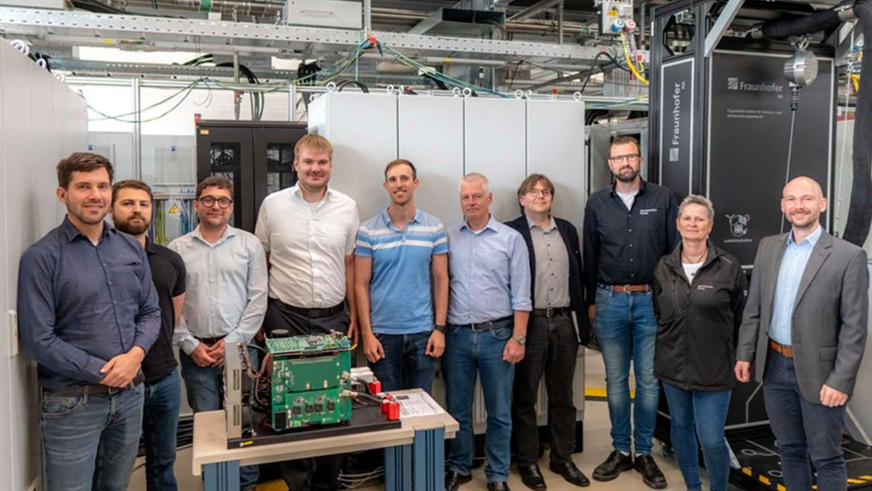
Fraunhofer ISE
A common DC bus links the AC grid, storage and charging output, enabling flexible power flows and load balancing. Crucially, this also supports the integration of on-site PV, with solar generation either used directly for charging or stored for later use.
Fraunhofer ISE pushes tandem efficiency beyond 34 percent
At the component level, the galvanically isolated DC/DC converter is based on a series resonant topology and operates at switching frequencies of up to 200 kHz. This allows inductive components such as transformers to be designed more compactly, contributing to a reported power density of 9 kW/l alongside a peak efficiency of 99.26 percent.
Modular and scalable
The modular design allows up to four 250 kW units to be connected in parallel, enabling scalable configurations depending on site requirements. The converter also covers a wide range of charging voltages and vehicle types, ensuring compatibility with both CCS and MCS standards.
Testing at Fraunhofer ISE's facilities in Freiburg included commissioning of the full MCS charging system and buffer storage. Using modular DC/DC converters developed by Motion Control & Power Electronics, the battery, AC grid and charging output were linked via a common DC bus. The setup again demonstrated charging power of more than 1 MW with a 500 kW grid connection, with the remaining capacity supplied by the storage. Trials across varying charging durations and storage sizes showed consistently high transmission efficiencies from grid to vehicle battery. (TF)