



A research project involving the engineering firm SPV Sonneburg, Geisenheim University and the Fraunhofer Institute for Solar Energy Systems (ISE) is testing a mobile photovoltaic system developed specifically for vineyards. The aim is to protect young vines from heat and drought stress during their first years while generating renewable energy. “We set out to develop a flexible system that is straightforward to install and dismantle, and can be relocated to another plot after a few years,” says project leader Paul Weinbauer.
Lightweight modules span vines
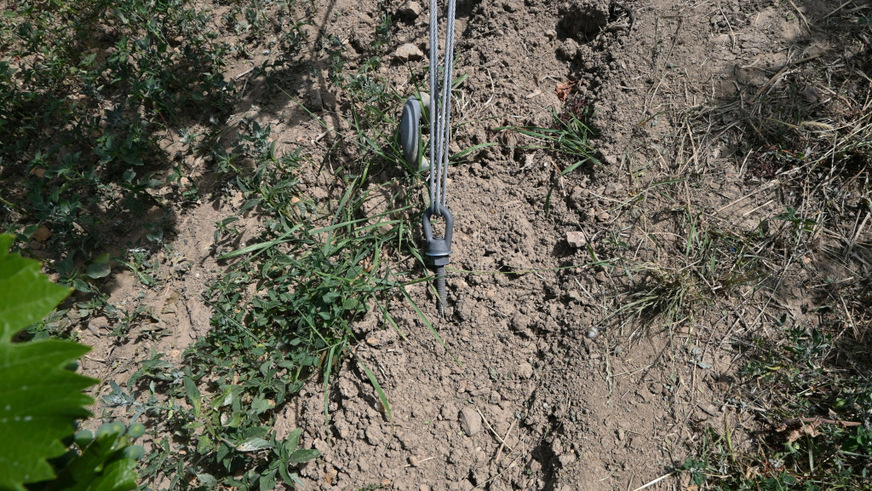
The system builds on existing vineyard stakes, which are reinforced with steel cables to support the structure. In Geisenheim, special anchors are driven around 3.5 metres into the ground to ensure stability. Flexible photovoltaic modules from Mirai Solar are then mounted between the stakes using steel cables. Mirai Solar specialises in lightweight solar shading solutions. The company laminates the solar cells between polymer plates, resulting in modules weighing just 2.5 kilograms per square metre.
Stay informed on the solar energy transition — subscribe to our free newsletter
Transparency is determined by the spacing between individual solar cells. In Geisenheim, around 30 percent shading reduces plant stress, while 70 percent of the light remains available for growth. Depending on the level of transparency, the modules deliver between 100 and 175 watts per square metre. The test installation in Geisenheim has a total capacity of around 40 kilowatts.
Velka Botička
Modules retracted in bad weather
A battery storage unit supplies the control system, weather station and other consumers. “This allows us to use the energy not only for managing the system, but also for charging an electric vehicle,” explains Paul Weinbauer. The solar modules can be retracted into a depot attached to an extension on the vineyard stakes when strong winds occur – usually when there is little sun. This adds further stability to the lightweight structure.
Solar Investors Guide #11 – Agri-PV reimagines farmland for the future
Encouraging initial test results
In addition to climate protection and power generation, Weinbauer highlights a further benefit for winegrowers: targeted support for young vines. “The first years are decisive for the long-term success of a vineyard. Our system can significantly ease this critical initial phase,” he says.
The project remains in the trial phase, with minor technical challenges currently being addressed. Initial results are promising. “We are seeing clear improvements in soil moisture and reduced temperatures. That is exactly what young vines need in times of climate change.”
Thanks to its straightforward design, the system can be dismantled quickly and reassembled at another location. Once the vines are mature and no longer require protection, the installation can be relocated to a new site to shield newly planted grapevines. (su)