



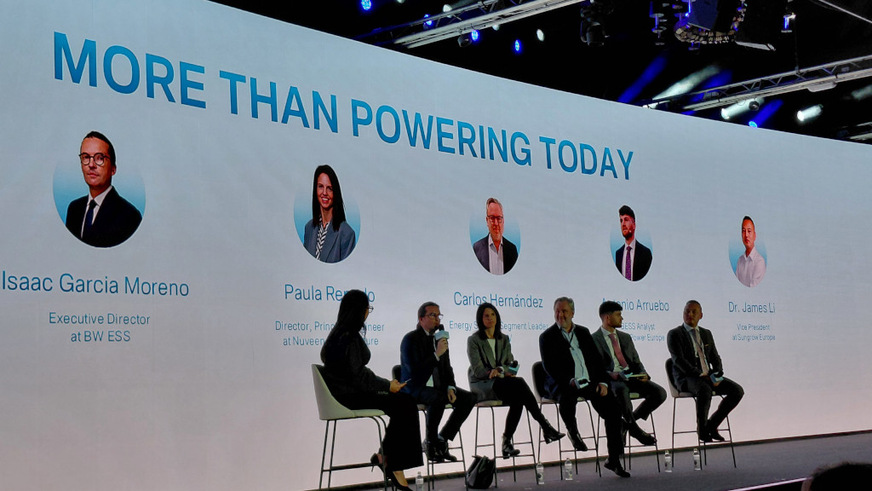
According to SolarPower Europe (SPE), cumulative EU PV capacity is expected to reach 406 GW in 2025. Integrating renewables into the power system presents challenges such as grid congestion, increased curtailment and negative pricing. SPE forecasts that flexible power demand will need to rise to 40 percent by 2030. As a result, large-scale battery energy storage system (BESS) deployment is increasingly important. In 2025, over 26 GWh of BESS were installed, with utility-scale systems surpassing residential for the first time. SPE predicts an average annual BESS growth rate of 30 percent, reaching 412 GWh by 2030, according to Antonio Arruebo, market analyst at SolarPower Europe, speaking in Madrid.
600 AH+ stocked battery cells – reduced lead time
PowerTitan 3.0 is designed to meet the challenges of today’s energy systems. Each 20-foot container combines a 1.78 MW power conversion system (PCS) with 7.14 MWh of battery storage, enabling a four-hour configuration where each block delivers 7.2 MW/28.5 MWh. The system uses stacked battery cells rated over 600 Ah, supporting discharge durations from two to eight hours. These cells enhance both safety and efficiency, resulting in a system-level round-trip efficiency (RTE) of 92 percent.
EU battery storage up 45 percent to 27.1 GWh in 2025
Thanks to its AC block design, PowerTitan 3.0 is pre-installed and pre-commissioned at the factory, and supports self-configuration and self-checks within one hour. This allows deployment of a 1 GWh project in just 12 days. The system operates without derating at temperatures as low as -40°C, making it suitable for Nordic and Alpine regions, as well as coastal and high-humidity areas.
Integrated DC/DC module
Alongside PowerTitan 3.0, Sungrow introduced its single-platform design for DC-coupled PV-ESS solutions. This includes a 1+X modular inverter with a dedicated energy storage interface, PowerTitan 3.0 with an integrated DC/DC module, and a proprietary PV-ESS Synergy Management System. The integrated architecture enables long discharge durations of up to eight hours, supports a flexible ESS power ratio up to 100 percent, and delivers system-level cost optimisation.
Designed to meet market demands, the solution supports effective energy arbitrage by leveraging peak and off-peak tariff differentials, while enhancing grid compatibility through optimised dispatch. To date, Sungrow’s DC-coupled solution has been deployed in over 90 projects across more than 10 countries.
Iberian blackout shows PV’s stabilising potential
Grid-forming technology
Grid-forming technology is emerging as a key enabler of resilient and stable power systems. At the summit, Dr Henry Liu, Director of Sungrow’s Grid Solution Department, highlighted its growing importance for supporting renewable-rich grids and meeting evolving EU standards. Core capabilities include voltage and frequency support, oscillation damping, gigawatt-level black start and system strength enhancement. These features have already been validated in landmark projects, including the 7.8 GWh installation in Saudi Arabia – the world’s largest grid-forming energy storage plant.
H.C. Neidlein
Active in Europe since 2011, Sungrow has expanded its regional presence to 25 local offices, two R&D centres, 26 warehouses and three Training, Technology and Service Centres, with its European headquarters in Munich, Germany. Recent flagship projects include one of the largest BESS projects in mainland Europe in Belgium (800 MWh), the Bramley ESS project in the UK (330 MWh), the northernmost PV project in Finland (70 MW), and a 70 MW hybrid project in Turkey.
The PV & EES Summit in Madrid brought together more than 300 partners and industry experts, including representatives from SolarPower Europe, TÜV and DEKRA. (hcn)