



Although global renewable energy installations reached a new high, jobs in the sector increased by only 2.3 percent from 2023, totalling 16.6 million in 2024. The newly released “Renewable Energy and Jobs – Annual Review 2025” by the International Renewable Energy Agency (IRENA) and the International Labour Organization (ILO) highlights the growing impact of geopolitical and geoeconomic tensions, as well as rising automation, on the renewable energy workforce.
Renewables boom highlights growing regional divide
As in previous years, development remains uneven worldwide. China continues to lead in both generation capacity deployment and equipment manufacturing, driven by integrated, large-scale supply chains that deliver equipment at unmatched prices.
1.8 million renewable jobs in Europe
In 2024, China generated an estimated 7.3 million renewable energy jobs, representing 44 percent of the global total. The EU maintained its 2023 level with 1.8 million jobs. Brazil’s renewables sector employed 1.4 million people, while employment in India and the United States saw only marginal growth, rising from around 1 million to 1.3 million and 1.1 million, respectively.
Commenting on these trends, IRENA Director-General Francesco La Camera said, “Renewable energy deployment is booming, but the human side of the story is as important as the technological side. Governments must put people at the centre of their energy and climate objectives through trade and industrial policies that drive investments, build domestic capacity, and develop a skilled workforce along the supply chain. This is essential not only to meet the goal of tripling renewable power.”
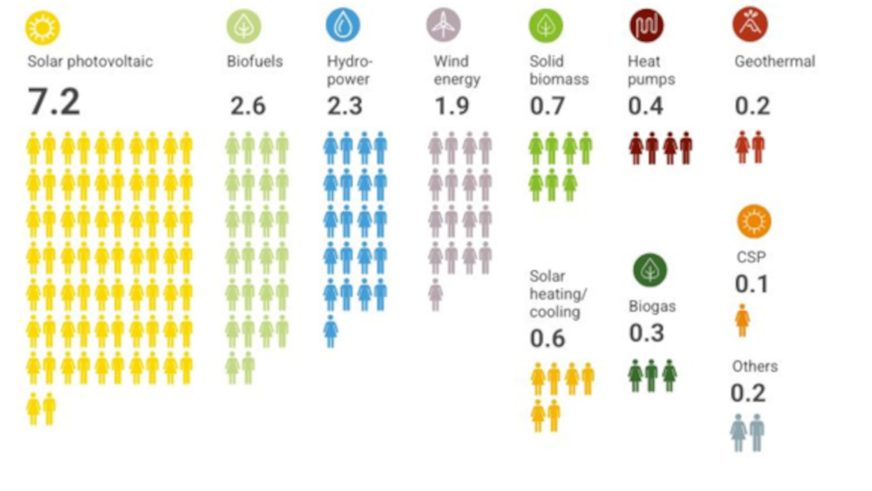
Solar photovoltaics (PV) remains the leading employer among renewable technologies, fuelled by rapid growth in installations and panel manufacturing. In 2024, the sector employed 7.3 million people worldwide. Asian countries accounted for 75 percent of global PV jobs, with China alone representing 4.2 million.
IRENA
Liquid biofuels ranked second, generating 2.6 million jobs in 2024, with nearly half of these positions based in Asia. Hydropower followed with 2.3 million jobs, while wind energy supported 1.9 million jobs globally.
Beyond the headline figures, this year’s report highlights the urgent need for greater inclusion and equity in the renewable energy workforce. A just transition depends on ensuring that all population groups. including women and people with disabilities, have meaningful opportunities to participate. The energy transition must be shaped by diverse talents and perspectives. So far, the potential of these groups remains underutilised, underscoring the need for intentional and systemic action across the sector.
ESG: The EU wants to be a pioneer
Cultivating a culture that respects diversity and champions inclusion and fairness requires sustained, inclusive policy frameworks – including accessible education and training, labour market services, and other supportive measures. Designing and shaping such policies demands that all stakeholders have a seat at the table, especially those who are too often sidelined. Discriminatory practices and outdated social and cultural norms must be set aside if the energy transition is to deliver more prosperous economies for all members of society. (hcn)